This is the song of Queen Aliissá Suncrown, beloved Highborn Stormbringer, Love of the North-Northwest.
Aliissá was born when the Sun shone upon the Dawn-Snow atop the ancient mountains of the Far North. She was born again upon the North winds, which carried a summer thunderstorm to the ancestral archepelego in the southwest, showering its crystal coasts and shining meadows. In those days, Queen Aliissá was known by another name, a title she was granted by her island forebearers.
Aliissá grew and travelled for twenty-eight years (according to the Calendar of Men), at which point she came to the land of the Great Forest to meet with the Royals of the City of the Ancestors. But the Forest People did not recognise Aliissá, for she did not yet bear the Mark of Royalty and they feared and distrusted travellers from the Summer Lands. So Aliissá was driven out of the City of the Ancestors, and she journeyed to the East through the Hall of Mirrors.
When she reached the Eastern Shores, Aliissá beheld a vision of a great oncoming storm and heard the voice of the Lady of the Rose. Aliissá journeyed across the Eastern Lands, which was also the Realm of Mania. There, she met with her Verse-Sister the Erin Triune, who told her that she would become again the Once-And-Future Queen, but not of the Eastern Lands. Aliissá knew she must travel to the Red Tower, for upon that tower the Red King resided, with whom she desired a meeting to discuss the concept of The Dreamer and The Dream. Aliissá crossed the River of the Elder Spirits to reach the Red Tower, which was also the Heart of the World, and from that point on she was to be known as Aliissá the Underqueen, ruler of Maybes, Could-Have-Beens and the Space Between.
Queen Aliissá confronted the Red King atop his tower, for she was born of the Far North and knew the secret of language. And Queen Aliissá said unto him: “Behold this Dream where the Dream and Dreamer are once again one. I say this to you in the words of our ancestors, and in so doing I speak a truth.” Then the Red King winked out of this world, for Queen Aliissá channeled the light of the ether through her words, and the radiant sound resonated with the beat and melody of creation. This is why Aliissá is called Queen Aliissá Suncrown.
Queen Aliissá then went North into the Future, where she found the Tapestry of Paradox beginning to unravel under the light of the Moon. She once again met the Lady of the Rose there, who claimed to be the Keeper of the Tapestry and Lunar-Annointed, but Queen Aliissá knew this to be a lie as the Lady of the Rose was a spirit and spirits always deceived because this was their way. So Queen Aliissá told the Lady of the Rose “Please bother me no longer with your trifles and deceptions. Who cares for you?”. The Lady of the Rose didn't have an answer to that, so she left.
Queen Aliissá knew that this night was to be The Night When The Worlds Came Together, because she had made sure it was to be so. She spoke with the Lost Shamans, who recognised her as an ancestor of the future returned to them in their time of need. Queen Aliissá knew what the Moon was and what it meant, and it was this knowledge that allowed her to travel safely among the spirits and reweave the Tapestry of Time by reinstating the sacred connection between the Land, the Sea, the Sky and the Inexorable Duality of Being. While in the Future, Queen Aliissá also was reunited once more with the Storm of the North, whose wild and mighty declarations were as lightning arcing the Sky and driving snow on the wind. Queen Aliissá stood atop the highest mountain and spoke with the Storm, and as their words flowed together the Sun shone through the blizzard and the air filled with powdered diamonds.
Queen Aliissá Suncrown and Bringer of Storms then returned to the Days of the Eastern Lands, and travelled the world for many years learning, growing and helping those in need. But eventually, the Time came when she had seen all there was to see in this Time. Looking once more at the Future, Queen Aliissá saw that the Border of the Worlds was deteriorating once more, and because this was a story she had already heard, she returned to the Southwest and the Island of Eternal Summer, which was her birthright. Queen Aliissá Suncrown remained on the Island of Eternal Summer for two hundred years and departed this plane with it when the island disappeared from mortal sight. Meanwhile, outside the Blessed Isle, the universe had changed again.
When the two hundred years were up, Queen Aliissá consulted with her Ruling-Friends on the Blessed Isle, for she had heard rumours of a dangerous folly and great disasters to befall the Far North. Secrets were being held that had the power to reshape creation, and the Time had come once again to travel. Queen Aliissá's Ruling-Friends (who above all else understand and respect change) agreed, and advised her to be wary of the ever-shifting Poetic Geography of the World As It Now Was. The Blessed Isle itself remained “gone” in the mythic sense, but it too could feel the undercurrents of change brought on by the Voice of the Possipoints.
In the Far North, Queen Aliissá bore witness to the return of the the Master of Speech, brought upon by the Awful Fighting of the Men of the North. The Master brought with him an army of Philosophers, who declared they would lord over the story by divine right of their discourse and debate. Queen Aliissá sought the guidance of the Blessed Sky Men of the Land of Eternal Winter, who recognised her as one of their own come to them in their time of need. Queen Aliissá remembered her kinship with the Men of the North then, and was once again adopted by them, and they cheered her on when she brought down the Master of Speech with the power of her voice and the swiftness of her blade. But Queen Aliissá took pity on the other Philosophers, especially the Old Dragon, whom she had known fondly in a time before creation, and the memories of those shared summers Long Ago and Far Away allowed him to ascend to the Plane of the Ancestors.
Queen Aliissá also knew the Men of the North were looking for a powerful Construct of Future's Past, and that this would cause the Erasure of History. Infinite possipoints recoiled in terror as the forces of the Master Narrative tapped into the Sacred Architecture, and it was only when History Folded In On Itself that the world was saved again. But this Construct was not the person Queen Aliissá was looking for: Her identity was revealed when Queen Aliissá forged an alliance with the Daughter of Blood and Steel to slay the King of Leeches, who sought to translate the Master Narrative for the Sunrise. Remembering her fealty to the Eastern Lands, its Triune and the Dawn Times, Queen Aliissá helped the Daughter of Blood and Steel remember the Sigil of Royalty and slay the King of Leeches, as she had done in the past. This is why Aliissá is called Queen Aliissá Suncrown.
Queen Aliissá and the Queen of Blood and Steel shared many adventures together after this, such as the Story of the Tonal City, The Journey to the Ether Upon the Wings of the Engines of Music and a return to the Present of the Future, where both Queens were remembered by the Lost Shamans. After this, Queen Aliissá and her Sword-Sister,whom she Loved dearly, parted ways in body, but not in mind or spirit, and the Young Queen (who was also the Triune) returned to the future upon the Winds of Tomorrow, where she met the Lieutenant and became the most beloved Saint of Gold, who was also known as Tomorrow's Guardian. The Saint of Gold had many adventures and made many close friends of her own, and the Universe itself recognised her Voice as the Blessed Melody of the Ancestors. But this is not her story.
Aliissá was born when the Sun shone upon the Dawn-Snow atop the ancient mountains of the Far North. She was born again upon the North winds, which carried a summer thunderstorm to the ancestral archepelego in the southwest, showering its crystal coasts and shining meadows. In those days, Queen Aliissá was known by another name, a title she was granted by her island forebearers.
May 4: Born on the first breath of summer, the Dream-Child finds the Walking Way.
November 4: The crown is seized for the Empire of One, bringer of summer to winter.
May 4: The Woman-Goddess convenes the Summit on the Mountain and touches the Sky.
November 4:
Birth and Death and Order and Chaos are two sides of the Looking-Glass that intersect at the turning of the year. The In-Between days remind us that such things are universes apart brought together at the World Tree, the I. Dreamers of Godhood within the Dream of Godhead. We exist at the point between opposite extremes where opposite extremes exist together within themselves. The Mirror-Globe reflects images of ourselves and our own future-past. And so it all begins again.
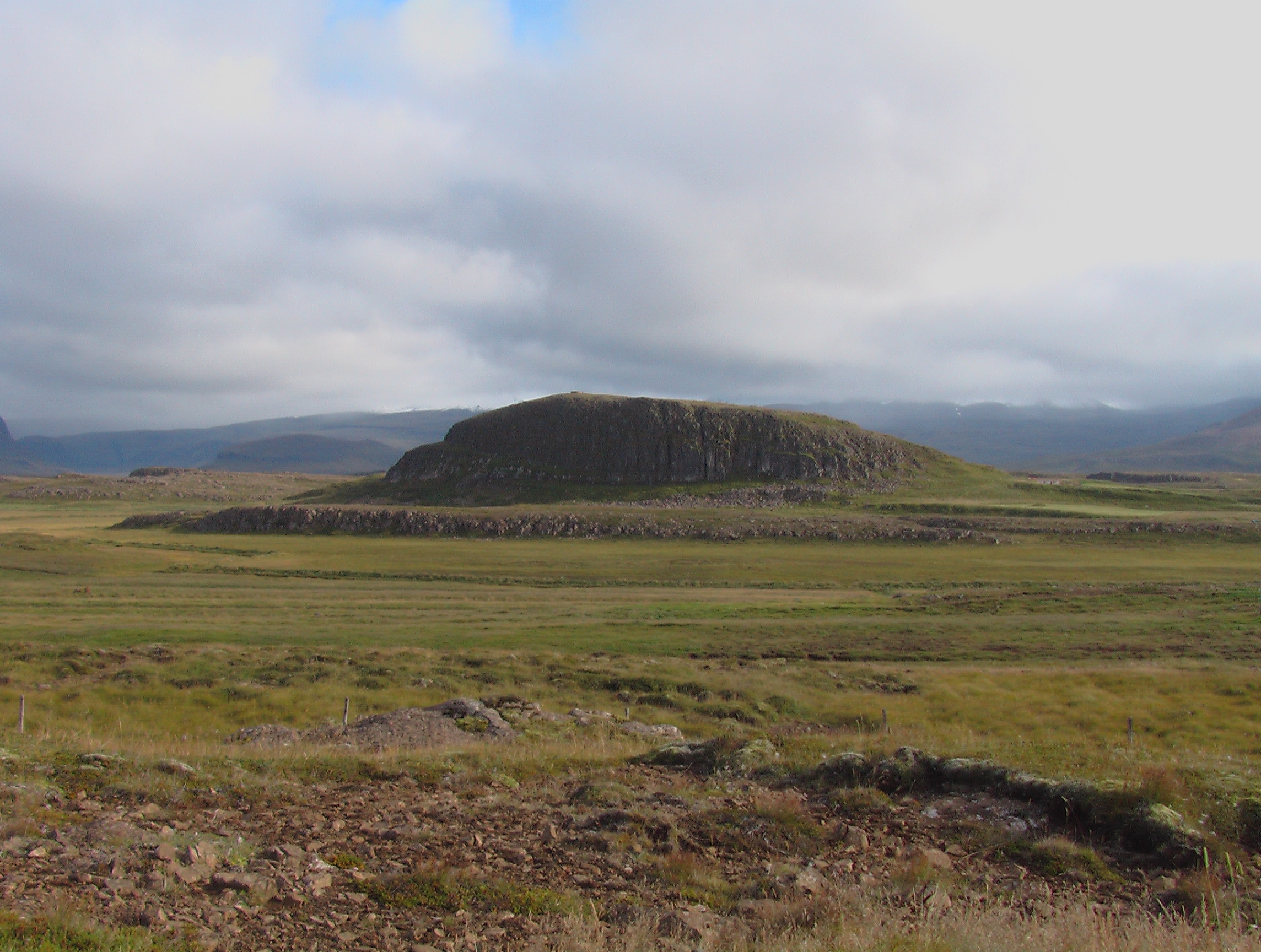
Helgafell. Myths tell us this is the burial mound of the Icelandic heroine Guðrún Ósvífrsdóttir. It is venerated as a sacred place of peace and enlightenment: It was the birthplace of the historian Ari Thorgilsson the Learned and once held a library of knowledge. It is also, perhaps because of its resemblance to a house with a door, seen as a gateway to other worlds.
What do we mean when we talk about Homeland? It's a question that has occupied my mind a lot this year. I was born and raised in Vermont and have spent my entire life here, but for the longest time I never considered myself a serious “Vermonter”, except by tautological default, largely because I guess I never knew what that really meant. Every place has a regional identity, and Vermont is no different, but “Vermonter” definitely means something special over here. It's just it took me awhile to figure out what that was, possibly because I've tended to be as isolated from my fellow Vermonters as much as I've been isolated from everyone else (not typically by choice, I hasten to add).
My parents moved here from Southwestern New York, bluntly, to hide. They wanted to be left alone and to be closer to the wilderness. Also though, I think they moved here because it reminded them of the United Kingdom and the British Isles, of which they're both enormous fans. There's a settlement on a mountain fifteen minutes away from me called New Ireland, and just beyond that is the stretch of land known as the Northshire, which is pretty much like what it sounds like it'd be like. They don't call this part of the United States New England just because it was the first place the pilgrims settled: There are parts of the Northeast US that would catch the eye of any Anglophile or visitor from across the pond. This all made sense to me. Until recently.
There are very few events I've lived through that I can decisively point to and say they conclusively changed my life. I can count them probably on half of one hand. Late 2010 into 2011 was a confluence of those events, including a chance meeting with a quirky and esoteric band of bloggers and Internet writers who would go on to become some of my closest friends and the first people I could comfortably and unhesitatingly call colleagues. But there are two important ones for the context of this piece: First was Vermont's behaviour in the 2010 midterm elections, in which a party of people advocating the state's secession from the United States and transformation into a anarcho-communist republic based around localist ideals blindsided everyone by walking away with a staggering 20% of the vote. They haven't made a lot of noise since, but our state has one of the most uniquely creative and progressive approaches to local politics you'll find anywhere in the US and is a natural breeding ground for that kind of thinking. This was the first time I realised how deathly serious we were about that. Vermont is one of the only places where the heart of the true and truly radical left still beats loudly in this country, and I suddenly realised I was a fit for this place.
But what actually is Vermont? I can't tell you objectively, as no-one can. But I'm sure my fellow Vermonters have a lot of strong opinions about it. I can, however, speak from my own personal experience. And I don't think Vermont is part of New England. I think it's something else. Whenever I spend time in Connecticut or Boston I don't really feel at home there. It doesn't feel like part of the same larger entity to me: It feels more like whenever I visit the Mid-Atlantic: It's close, both geographically and climatologically, and there's certainly a continuity, but it's not quite the same thing (no offense meant to my dear friends Phil and Maddy who do live in Connecticut and Boston, respectively: I'm sure they have just as complex feelings about where they live as I do). New Hampshire and Maine might be closer, but I still find them regionally distinct enough.
I'm not just talking about our quirky politics and local identity. There's an energy about this place I notice that I don't find everywhere. This year I read a wonderful book called Running with the Fairies which is an ethnography of the “Fairy Faith” in Ireland, which is in some ways an evolution of the earlier NordicXCelticXGermanic animism and folklore blended with bits of later Christian teachings. They use much the same language, saying that the Earth Magick, which they associate with the Fairies (who can be air or earth elementals) is stronger in some places than it is in others. The only other place I know I've felt a similar power or presence so far is, weirdly, Cape Cod, which is about as distinct from the rest of Massachusetts and New England as Vermont is...and almost as distinct from Vermont. Cape Cod is the place where the land disappears into sea and sky. The Outer Lands. It is, in the words of its greatest biographer, the Outermost, closer in kin to the Atlantic Ocean then to North America. It's also, funnily enough, probably the only other place in the US that has as staunchly radical, progressive and fiercely independent identity as we do. The exploits of Provincetown alone, at the very tip of the island, are legendary.
My parents always joke that I was born in the wrong part of the world. That I'm really a sea person who should move somewhere more tropical. It is true that I'm a surfer and subscribe to a lot of the beliefs and philosophies of the old surfers from Polynesia (not so much the commercialized glamour show of Southern California). I've had a fascination with that part of the world for years, and some of the first works that really captured my interest were nature documentaries about the ocean and movies like Disney's The Little Mermaid.
Cape Cod, thanks to its unique location, has really bizarre weather patterns. It's in the North Atlantic, but it attracts plant and animal species more commonly found in subtropical and tropical coastal environments, typically as it's a convenient pit-stop during the migrations that happen in the leadup to every winter and summer. Thanks to deforestation and the harshness of the ocean, the entire island is now covered in a twisted, gnarled, dried-out blanket of pine barrens, which just makes the whole place feel rawer and more elemental.
Cape Cod is home to the Woods Hole Oceanographic Institute, at one time the leading such institute in the world. Doctor Robert Ballard was based there, and launched his expedition to find the wreck of the RMS Titanic from Woods Hole. I wrote him a fan letter once.
Skálholt map, showing Norse conception of the Americas. The Vikings told of settlements in a region of North America called Vinland, or "meadow-land" where there was no snow in winter. Some scholars have placed the settlement Kjalarnes at Cape Cod.
The other event from 2010 and 2011 that changed the course of my life was the launch of The Elder Scrolls V: Skyrim. Skyrim is a serious contender for not just my favourite video game ever, but my favourite work of fiction period. But you should probably know that given the fact I can't seem to stop talking about it. I initially just picked up Skyrim simply to give the series one more shot: I'd played an Elder Scrolls game once before, The Elder Scrols IV: Oblivion, at the start of the seventh generation, but it failed to really grab me. I really liked the concept of an open-world action RPG where player choice and the freedom to explore, not just the sprawling world but your own individual experience of the world, was paramount. But the Cyrodiil of Oblivion did nothing for me: It was one big expanse of identical green fields that was the setting for what seemed to me to be a generic rip-off of J.R.R. Tolkien. I didn't know anything about what The Elder Scrolls' Tamriel really meant. Skyrim fixed that for me.
At the beginning of Skyrim, just as in the beginning of any RPG, you're asked to design a character. The Elder Scrolls gives you a choice of eight possible races and two genders: Knowing next to nothing about the background lore of the series I arbitraily made my character a female Nord, as I knew Skyrim took place in their homeland and the player was supposed to be hero of Nordic mythology. It made sense at the time. I gave her a name that was a variation on the name of the heroine of Jan Brett's book The Wild Christmas Reindeer, a story I remembered once enjoying about a spirited stablehand who herds Santa's reindeer. Brett has written many other books set in Scandinavia and the other real-world Nordic countries, and I always appreciate how her meticulous illustrations convey the worlds of the far North she seems to love so much so well.
If you're as unfamillair with The Elder Scrolls as I was when I first started Skyrim you would be forgiven for thinking the Nords are simply a stand-in for the Vikings, in particular the generic barbarian Vikings so common to fantasy stories. Start to pay attention to the game a bit more though and you'll find that's not really the case: None of the races in Tamriel have direct real-world parallels. They all draw upon many different cultures, myth cycles and belief systems to create an identity that's at once unique to The Elder Scrolls and also very logical extrapolations and exaggerations of real world patterns of human migration. While the Nords do in many ways resemble Vikings, they're actually far closer to what we know of the pre-Christian, pre-Norse GermanicXCelticXNordic inhabitants of northern Europe and also seem based quite heavily on ancient Egyptians, the Stone Age Megalith builders and, especially in the case of the Skaal (an isolated group of Nords living on the far northern island of Solstheim between Skyrim and Morrowind), the animistic shaman beliefs of the idigenous peoples of the Americas, the Inuit, the First Nations of Canada and the Sami of the Nordic countries.
Very quickly my choice to play a Nord became a retroactive no-brainer. As I was gradually drawn more and more into the game's world I started to feel as connected to the land of Skyrim as its own people do. Skyrim, as a place, means a lot to me now, as much as any real-world “homeland” might. I am still religiously playing the game nearly two years after it was released and have, as of this writing, clocked a little under a thousand hours into just my PC copy. I probably know my way around Skyrim better than I do a lot of real places, and I hardly ever use the game's fast travel feature anymore. I know exactly where I'm going, and I love the land so much I need to experience as much of it as I can. But that's the thing about lands like Skyrim: They are real places: The Tamrielic monomyth tells us the world came into being by the intersection of the primordial forces of Order and Chaos, of Stasis and Change, in the Dreamtime. Chaos traumatically inspires Order to create, and Order creates by lucid dreaming of Creation. Skyrim, like everywhere in Tamriel, is a world built around ideas and dreams and given life by its people, who are all dreaming of it.
One thing the Nords share with many of their Elven counterparts (though they'd never admit it given the longstanding hostility between humans and Mer) is their fixation on what has been described as a process of mythogeneosophy: A Sacred Geneaology that traces their lineage back to the Dawn Times. The primary difference between them and their enemies the Altmer is that the Nords much prefer mutable oral history to staunch objective, obsessively curated records. A Master Narrative for a people who have a troubling tendency to fancy themselves a Master Race. The Nords, by contrast, turn to their history and myths as guidance for how to live their lives day to day, and minor things like “historical accuracy” (if such a thing can every really truly exist) are acceptable casualties if the alternative is giving up a good story that might could help shed new light and new perspectives on whatever current crisis they might be facing. We frequently turn to our heroes, idols, role models and the stories we heard as children in the hope they might help us come to terms with adulthood, and in the process we constantly re-interpret them.
Lewis Carroll always felt children (though really, girls) had a kind of perspective worth holding onto throughout life. Not the blissful naivete of children per se, but more the sense that the world is a grand and wondrous place and that some form of appreciation and acceptance of this makes us happier and healthier, a perspective shared by Shigeru Miyamoto. Maybe that's why we still turn to supposed children's literature like Carroll's Alice in Wonderland diptych, or Miyamoto's Super Mario games...and why works like those are frequently deeper and more meaningful than about 95% of the stuff targeted towards adults. Of course there's no way I could ignore the Once and Future Underqueen on her summoning-day: There's no way she would allow this, and the Dreamtime's Chessmaster checkmates again. As she always does. As she always will.
Alice by Antichristofer
is a similar interpretation of the Underqueen and her realm to mine. To
me, this version of Wonderland bears an uncanny resemblance to
Morrowind. Using DeviantArt's "Browse More Like This" feature on this picture gave me fanart for The Elder Scrolls V: Skyrim.
A long time ago, perhaps as many as two decades, I once watched a nature documentary about a woman who lived alone deep within the Boreal Forest of Canada. She was fascinated by the lives of the local moose (known as Elk outside North America) and spent her days trying to join their community and painting gorgeously elabourate portraits of scenes of taiga life. I don't recall much about that special, though I remember the lady's name vividly: Gisèle Benoit. The idea of studying animals from a cultural perspective has always fascinated me. It dates back to the earliest forms of naturalism, back before, like all life sciences, it was subsumed by and folded into the monolithic engines of celular biology and neuroscience. From a zoology perspective this is often called ethology, although it's in many ways actually closer to ethnography and the Kratt Brothers (another team of modern-day naturalists who were big inspirations on my relationship with wildlife) call it “Creature Adventuring”. In fact, this is the primary reason I'm such a big fan of the Pokémon franchise, and what was going to be the philosophical underpinning of the multipart retrospective on that series that's supposed to be here. This was also the primary reason I abandoned the natural sciences to pursue anthropology instead. Years later, Donna Haraway, one of my biggest anthropological inspirations and one of my very favourite writers and thinkers wrote a book entitled When Species Meet, outlining the framework for a new philosophy she called “multispecies ethnography”.
I've always felt a kind of kinship with Canada as a whole, though I've never really been consciously aware of it until recently. I'm closer to Canada than I am to a lot of the United States, and in perhaps more than just a geographic sense. In the 1990s one of the only other television series I made a point to watch whenever I came on apart from Star Trek or Scooby-Doo was Acorn the Nature Nut, hosted by Alberta-based entomologist John Acorn. Like the Kratts and Gisèle Benoit, John Acorn was another naturalist on whom I based my conception of nature. Acorn was also known for his distinctive dry, understated tongue-in-cheek humour also shared by The Arrogant Worms, one of my favourite music acts, and that has been described as distinctly Canadian. I've sometimes been told I have a similar sense of humour. One of my favourite TV shows now is still Survivorman, hosted by Ontario native Les Stroud. What intrigues me the most about Survivorman isn't so much the survival techniques Stroud is ostensibly teaching us, but how intimate he seems to become with the land when he's alone in the wilderness for seven days. The show is as much about our connection to nature and our natural roots as much as it is about what to do if you crash your bike in the Canyonlands in the middle of winter (this is, incidentally, what's missing from not just every other survival show, but every other contemporary nature show period).
I don't know what possessed me to, randomly out of the blue, look up Gisèle Benoit online recently, and for what purposes. But I did, and I was curious to see if she had done anything else in the intervening twenty years or so. It turns out she has: She still lives in the Boreal Forest with only her parents and the animals for company, and has put out documentaries, paintings and art books hoping to chroncile the ebb and flow of life in the northern forests and to, in her words, “renew the sacred bond with nature”. One of her more recent masterpieces is a mammoth tome of an art book called Cascapédia, a comprehensive look at life in the titular region through her perspective. Although the book is now out of print, Benoit put the whole thing up on her website for free with annotations under the book's sketches and paintings, all of which bristle with her signature power and emotion. Cascapédia is just what I remembered Gisèle Benoit's work to be like, and, astonishingly (though perhaps predictably) I was taken aback at how much her artwork reminded me of Skyrim: Her renditions of Cascapédia are equally evocative of the atmosphere and energy I sense in Falkreath and Whiterun.
Every once in awhile I'll cross the border into New York with my family. This is largely because if we need to get any substantial shopping done, it's impossible to do that where we live. On the highway coming out of the border town of Bennington and leading towards Albany, there's a ridiculous tourist trap of a place called the Big Moose Deli just across the state line. It advertises itself as “the last stop in New York” and the place to go if you want to stock up on “Vermont Gifts” and souvenir kincknacks. And yes, there is in fact a gold-painted moose on the roof of the building. That and every kind of gaudy, tawdry eyesore you can think of piled up as far as the eye can see in the parking lot. Sadly, it's but one of many such institutions you find as soon as you enter the Mid-Atlantic (though it's probably the worst). Vermont is one of the only four states in the country where roadside billboards and advertising are expressly forbidden (the others being Alaska, Maine and Hawaii) and you don't need a “Welcome to New York” sign to let you know you've crossed over.
My family and I have debated on numerous occasions what precisely the purpose of the Big Moose Deli is. Do tourists think Vermont is one big empty expanse of forests and mountains and that the Big Moose Deli is the last bastion of civilization they'll bear witness to before boldly plumbing the heart of the wilderness? I mean, people do live here, and we can probably sell you better maple syrup, barbecue and handmade crafts. I suppose it is one of the highest profile places between the tri-city area and the ski resort communities if you don't ever leave the highway, and the Big Moose Deli enthusiastically sells itself as the “Gateway to Vermont”.
But that got me thinking that maybe Vermont is a kind of gateway itself: A Gateway to the North. Part of what makes us distinct is that our mountains are known as the Green Mountains, because they're heavily forested instead of rocky. But also I think it's because of our abundance of conifers when compared to the rest of the Northeast US. Climatologically speaking, Vermont is the gradient between two biomes: The mixed broadleaf forests characteristic of southern New England (excepting Cape Cod) and the taiga of Canada. The Boreal Forest. Ironic for a state famous for autumn leaf-watching tourism, the further north you go the more pines you see (and the fewer deciduous trees) and the more and more Vermont starts to look like a proper Northland. Vermont is the space between.
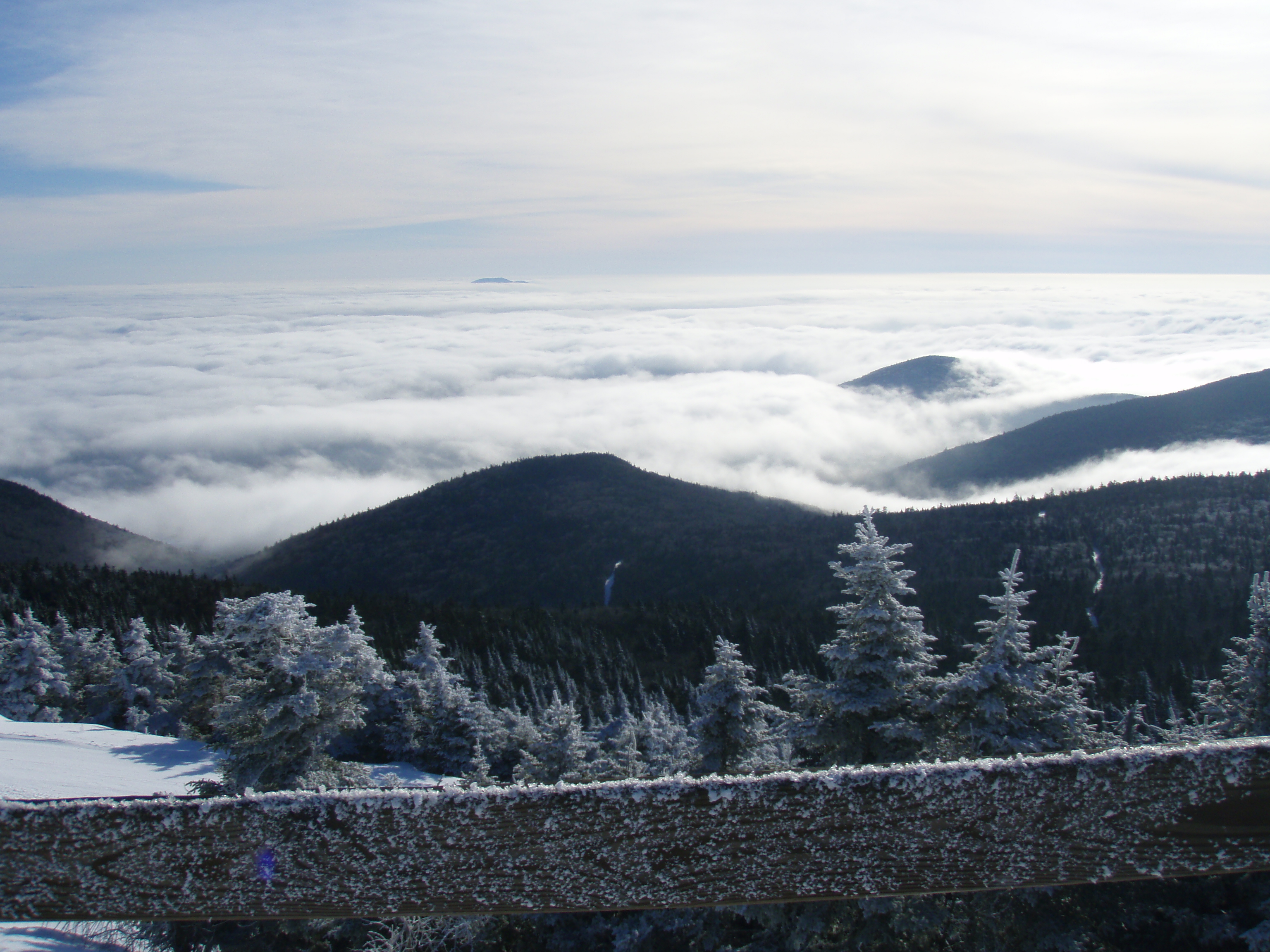
View from the summit of Killington Peak, home of Killington resort. Nicknamed "The Beast of the East", Killington is one of the largest and most challenging descents on the eastern seaboard. Nowadays, it also incorporates the resort at Pico, its neighbouring mountain. Pico is the oldest ski resort in Vermont, founded in 1937 by the Meads, a family of Norwegian immigrants. Daughter Andrea was an Olympic gold medalist. Pico can be seen in the distance.
The closest Canadian province to me is Québec, and I do now wonder how much being so nearby has shaped my positionality. I'm far enough north to feel closer to my neighbours in Canada than to my neighbours in New England or the Mid-Atlantic. In many ways I now consider myself a true Northerner. That said, I'm also far enough south to be disconnected from the sociopolitical machinations of the province, which, given Québec's staunchly and infamously nativist and racist history is probably a good thing. Québec is also where Gisèle Benoit's legal residence is, though the fact she spends most of her time distant and removed from human society in the forests of Cascapédia leads me to wonder how connected she feels to the strife and upheaval going on around her. We were all Wandering Ehlnofey in the Dreamtime. It was the Old Ehlnofey who turned to isolationism, but they did so out of insular, incestuous xenophobia, not a desire to become close to the land and the sky. It was the Wanderers who settled in Alt Mora, the Elder Wood, who learned how to do that.
Concept art for Elise Riggs from the 2012 reboot of SSX. Elise (played by Lucy Liu in SSX Tricky) is a Canadian snowboarder, surfer and base jumper. She's one of my biggest idols and role models. One of my favourite levels in the original SSX Tricky is called "Aloha Ice Jam" and is set on a glacier that's been towed from the arctic to Hawai'i.
In talking about the Alice in Wonderland diptych, Martin Gardner (who, in spite of the numerous problems he had in regard to his scholarship and motives in his other fields and careers, probably remains the foremost authority on Lewis Carroll) once mused on the irony of the mathematician and Reverand Charles Dodgson becoming most famous for his “pagan nonsense”. Gardner was most likely talking about how curious it was for the formative work of Victorian children's literature, and really all children's literature, to have nothing to do with Christianity, or really Westernism in general (indeed, its status as one-part venomously barbed social satire makes it rather the opposite of those things), but I'm going to take him literally. Alice is a pagan queen.
While Alice in Wonderland is very British, it's most evocative of the parts of British culture that predate the arrival of Westerners: All the references to the sídhe, (and to Elves in the working title) and to Otherworlds (including, debatably, Tír na nÓg) make this rather self-evident. It's also quite critical of the parts of Victorian Britain that come out of Westernism, most notably its attitude towards royalty: Gardner describes Carroll as a Tory royalist, but he's always seemed more ambivalent on this front to me and illustrator John Tenniel, a famous polticial cartoonist at the time, certainly seems less enamoured with the whole prospect. Either way, with or without Carroll's and Tenniel's positionalities, it's perfectly easy to afford the work this reading, and I'm not the first to do so.
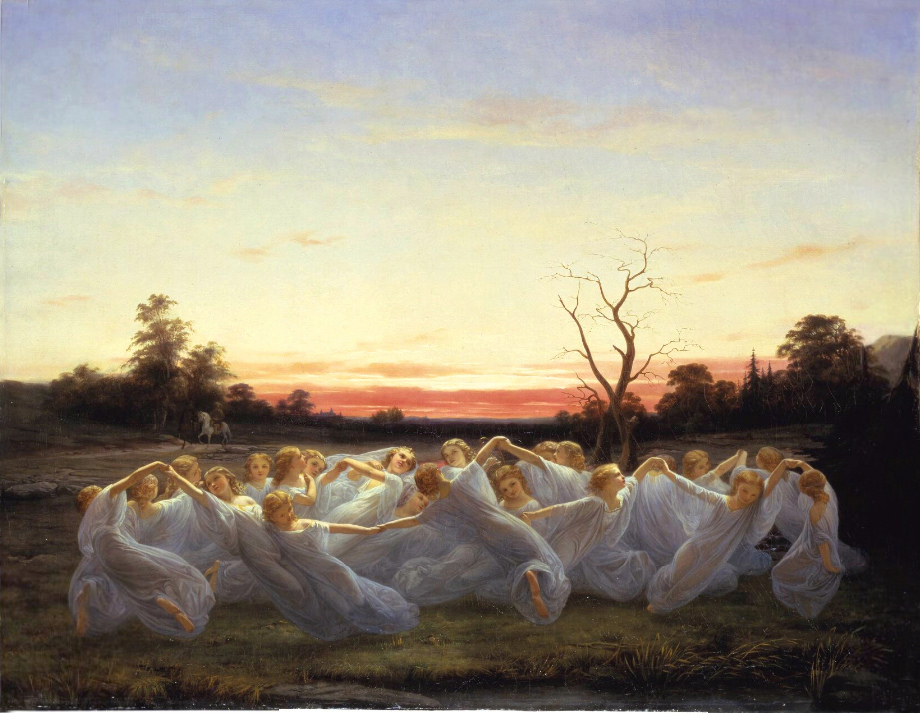
Meadow Elves, by Nils Blommér, depicts a gathering of Light Elves from Álfheimr, one of the nine worlds of Norse mythology. It is said Elves, like all spirits, would gather to dance on the hills during the festivals of Beltane, Midsummer and Samhain.
One of the things that's most impressed me about the history of the Tamrielic Nords is how logical and sensible it actually sounds. While, as I said, the Tamrielic races have no explicit real-world analogues its tough not to spot the influences in Nordic culture. They're Northerners, and it was through The Elder Scrolls I was finally able to come up with a theory about what that might mean. The Nords, the original Nords from Atmora, not the ones who absorbed too much influence from the Cyrodiilic empire and the Dragons they once revered, were mystical, animistic shamans for whom living as harmoniously with the land as was possible was a virtue of paramount importance, and they worshiped the sky as the domain of deified ancestors, and to understand all of this was to understand enlightenment. These are traits the Tamrielic Nords very overtly share with real-life Northerners: It's a cultural model shared by the Indigenous Americans, the Inuit, the Sami, and the real-life pre-Christian, pre-Norse Nordic peoples, and it decisively sets them apart from Westerners: These people are far more similar to each other than they are to those who originated from France, Italy, Spain and Greece. And its to them who I feel I might share a strong kinship with as well.
Fanart by Rafaken of the Throat of the World, the mountain serving as the symbolic and literal centre of the land of Skyrim. Also debatably the tallest peak in Tamriel. It is said the snow on the Throat of the World cannot melt, and dates back to the Dawn Times. The Nords believe humans were created when Kyne, wife of Shor, breathed life upon its peak. Nowadays, the renegade Dragon Paarthurnax, leader of the the Greybeards (a pacifist order of Nordic monks who devote their lives to worship of the Sky), meditates here on the concept of Voice, and how it can be used to touch divinity.
I suppose this would raise the question of how I reconcile my newfound Northerner heritage with my pre-existing magnetic attraction to the ocean, especially the tropical Pacific. In Norse mythology, Skaði, the Jötunn goddess of winter, skiing and the mountains was once married to Njörd, the god of the sea. While together, they split their time evenly between their two realms, with Skaði spending half the year with her husband in the ocean and Njörd spending the other half with his wife in the mountains. But neither was happy with this arrangement, and each would long for home while away from it, so they eventually divorced. But, strangely enough, I find the people the Northerners are most similar to may actually be the Polynesians.
In Donkey Kong Country 3: Dixie Kong's Double Trouble! and its sequel Donkey Kong Land III, Dixie Kong travels to the "Northern Kremisphere", a Northlands-inspired environment south of tropical Donkey Kong Island, eventually discovering the "Lost World", spoken of in myth and legend. The Northern Kremisphere, much like the Kongs' homeland, features tropical jungles intermixed with snow-capped mountains. The Donkey Kong Land series was one of my first real video game loves. Dixie Kong returns in 2014 in the WiiU sequel Donkey Kong Country: Tropical Freeze, by Retro Studios (known for Metroid Prime) and which features Vikings landing on Donkey Kong Island.
Both groups have similar attitudes towards oral history and both revere deified ancestors and elemental spirits. Most critically though, both placed great importance on the interconnectedness of worlds, in particular that of human life with the nature, as they are ultimately one and the same. Both also felt tied to their lands in a very deep and meaningful way-It's just the Poylnesians' “land” was in fact the Pacific Ocean. Indeed, both the Polynesians and the Norse Vikings were exquisite navigators (though the Polynesians were unquestionably superior): In fact, Te Rangi Hīroa's landmark ethnographic history of the Polynesians was titled Vikings of the Sunrise...and was cited by H.R. Ellis Davidson in her comparative analysis of the Celtic, Norse, German and Nordic peoples Myths and Symbols in Pagan Europe: Early Scandinavian and Celtic Religions.
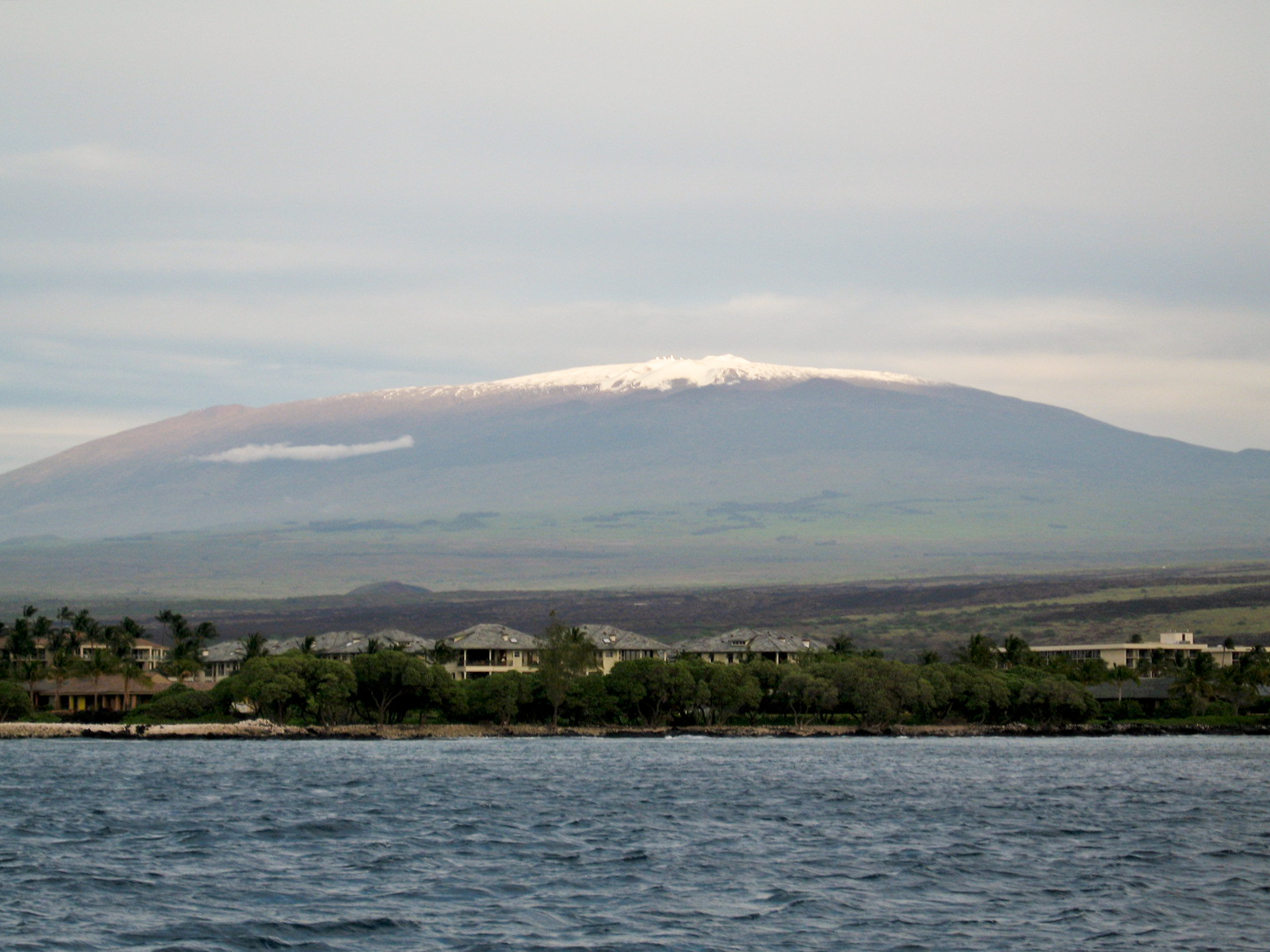
Mauna Kea, as seen from the Ocean. The tallest peak in Hawai'i. Known as Mauna o Wākea, literally "The mountain of Wākea" in the Ancient Hawaiian, and seen as the land of the Gods, home of kind and helpful spirits, the seat of the sky deity Wākea and realm of Poliʻahu, goddess of snow.
I suppose I exist between extremes, or perhaps more accurately where extremes intersect. The Celts divided their year into a light half and a dark half, but it was the in-between times, when both light and dark comingle, that was the most sacred to them. I've never much cared for Fall. Actually, I loathe it. I much prefer Summer and Winter. Like the spirits, I celebrate midsummer and midwinter, but I'm most energized at Samhain and Beltane when summer and winter begin and end and coexist simultaneously. That's when I come alive.
Concept art for Tundraful, the second level of Alice: Madness Returns-American McGee's (of id Software fame) Gothic and surrealist re-interpretation of Alice in Wonderland.
May 4: The Dream-Child takes the Walking Way and learns to Dream.
November 4: The Dreamer Dreams anew, and henceforth Dream becomes Dreamer.
May 4: The Walking Ways lead us to the Mountain, upon which we may touch the sky.
November 4:
SummerXWinter. LightXDark. SeaXSky. These are the names of the Looking-Glass that we find at the turning of the year. The In-Between days remind us that such things are universes apart brought together at the World Tree, the I. Dreamers of Godhood within the Dream of Godhead. We exist at the point between opposite extremes where opposite extremes exist together within themselves. The Mirror-Globe reflects images of ourselves and our own future-past. And so it all begins again.
May 4: Taika, who is Ysmir Storm-Crown, returns as Adaleiz, born Adalhaidis of Atmora.
“Tamriel never belonged to Bethesda. It was the other way around.
As for canon, it's really all interactive fiction, and that should mean something to everyone. That said, I appreciate and understand the stamp of 'official', but I think it will hurt more that it will help in the long run.
This is but one of many stories told to children by their village elders involving The Young Adventurer or Queen Alice or both or variations thereupon. As with all such stories, the details differ from version to version, although the fundamental structure is found in all of its forms. The accuracy with which the events chronicled within are described is of course suspect and a matter for debate. Readers are encouraged to formulate their own opinions on the Authenticity and Truthfulness of this particular account.
Join me atop the Sacred Rock, for here the All Thing resides.
Then the Young Adventurer ascended the mountain and came upon the Law Stone, which stood within an open meadow. Atop the Stone sat Queen Alice, thrice-exalted usurper and Lady of the Green, her legs folded in the manner of a Lotus, her head adorned with a Crown of deep red flowers. In front of her lay a succession of objects, perfectly arranged in a row. It was known by all that Queen Alice was to be consulted at this juncture, and so the Young Adventurer approached her forthwith.
“My Lady, I have journeyed long and travelled far and I must now seek your counsel. I wish to partake of your wisdom and experience so that I may deepen my knowledge of the Way of the Sword and Shield.”
“You needn't try and explain yourself so,” replied the Queen “For I know your true purpose. You approach me clad in green, or violet, or crimson, or blue or in cold metal or in a mighty helm of brilliant flame. You shall carry on doing so, and you will do so in the hereafter and times long passed. Your intent is surely clear enough; it's your meaning I don't follow.”
“I require training in the martial arts,” the Young Adventurer said “Or, barring that, some formidable tool of honour and power that will aid me on my quest. Is that not the purpose of this assortment of items between us?”
“What you see in front of you is what you wish to see” Queen Alice said “Or perhaps,” she hastily added “What you expect to see. I appear to you in this manner because I am expected to and am thus invoked, though I appear in this form because it rather suits me. We have met this way before and we shall continue to meet this way time and time again until the world grows dark and the land grows cold.”
Confused, the Young Adventurer countered “I see what I see in front of me because it is there and it was there before I climbed this summit. How can it be otherwise?”
Alice responded “What you see are half-truths; between us stands an impenetrable wall of nothingness. You bear witness to the simulacra of meaning and virtue.”
“Is a Thing Not-A-Thing? What I desire and what I am presented with have no correlation, as you are right now effectively demonstrating.”
“A Thing ca'n't be without its symbol.” Alice gestured to her collection of objects “I could give you this this canoe (which is the world) this book (which is the link in the chain), this ball (which is the aspect of thunder and lightning), this skateboard (which is the door and the eye), this cobra (which is the voice of the dragon) or this wheel (which is the tower) and each would be useless to you stripped of their subject. Furthermore I daresay they mayn’t even exist if you wished it.”
The Young Adventurer was now thoroughly confused, and asked of Queen Alice “What is the purpose of all these riddles and symbols? This is getting me nowhere! I've come all this way and I should like to have some answers to all of this.”
“They get you nowhere because you choose not to follow them, of course,” said Alice. “The secrets of which you speak and seek are spelled out before you; answers written in words carved out of summer's clear sky. Pick a path and follow it, for it shall lead you towards divinity.”
The Young Adventurer was growing angry and proceeded to criticize Queen Alice “Will you not give me what I seek, or are you simply incapable of giving it? Is a Queen not a Queen if I wish her not to be? For in you I see the simulacrum of a regent. Does a Queen not sit on a throne and preside over her land and people? Pray, tell me: Where do you rule and who are your subjects?” The Young Adventurer said this, for it seemed Queen Alice possessed none of these Things, then added one final question: “What Are You?”
“Is the answer to your question not already clear? Do the words not appear before you, though you are unwilling to read them?” Alice replied “I am the Queen without a throne, for my throne is the field of scented rushes. I am the Queen without a queendom for my queendom is the Earth, the Ocean, the Sky and the space beyond and between. I am ruler of everything and nobody. I am the third of two Queens of Dreaming and have no predecessor or heir for my apotheosis was my will. I am Woman-Become-Goddess and Goddess-Become-Woman. I am the form to which you must aspire.”
To this the Young Adventurer had no response, so Queen Alice thus continued “Do you not see some reflection of yourself in me? Is that not this reason you have come yearning for my company and guidance at this moment in time?” Alice paused for a moment, than continued “You seek wisdom and meaning. These are not Things I can give you, but things which you must discover yourself and absorb into your aspect. But you also seek knowledge of topics with which I have a particular experience. Such knowledge is the beginning of a path, so this I will tell you.”
The Young Adventurer raised no objection to this, for the quest must continue, thus there was no objection that could be raised. “Talk with me then about The Path.”
“There is not one Path, but many paths. The road and the destination can remain the same, but should the trees change colour or the cobblestones be re-layed, the path will likewise change.”
“Surely The Path remains the same? The Road still stretches across the same piece of land and it still ends up at the same place.”
“A road is only a Thing if you perceive it to be such. A road becomes a path when a Master perceives it to be one. Or perhaps rather, the path is the way to become a Master, but only a Master can recognise it as such. Either or both. The path is the Endeavour.”
Queen Alice knew this puzzled the Young Adventurer, for she had seen a vision of it doing so before the words left her lips, so she shared a story. This was that story.
“It is a truth that in the days when I walked alongside my foster-father I was a warrior, much as you are presently. A Warrior Queen assumes her mantle through combat, and I am coronated through the slaying of the High King: I slew him once in the Hills of Erin upon the raven’s wings, once in the House of False Love, once in the Mead Halls of the Gods and again atop the City of Fire. I likewise felled him amongst the Missing-Birds of Aetherius and in Darkness and in Sadness and then in the Dreaming, which is all places and all moments. The clashing of our swords echoes back to the dawn of time and forward to the End of All Things.”
Alice continued “My infinite victories win me only my self, which is nothing, yet everything. This is true inasmuch as it happened, I exist, and therefore this must have happened. But it is also a truth that in those days I wore the Storm Crown and thus did righteously slay the High King, for he knew not Love, and had I not the world would become Poison and I should cease to be.”
“So one becomes a Master by finding a path, following that path, and slaying he who resides at the end of the path.” The Young Adventurer offered.
“It is a truth that heaven may be reached by violence,” Alice responded “But I slay kings with Love myself. They are not such disparate forces, you know. The House falls for it promises Love where there is none. A real Master knows the value and power in this.”
“What more must a Master know?”
“That a Master is not a Master until The Name is both spoken and forgotten. Only then can Masters recognise themselves and attain liberation, wisdom and power, which are the same. I am Alice and I am Not, but I Am. This is the true purpose of the path, for the path is the Endeavour. One needn't worry so much about the end of a road, it's the walking that's important. After all, one ca'n't go around slaying kings all the time, now can one? Bearing the Sun Crown I travel where I may; my processional train the daylight of summer itself.”
“But the warmth of a summer's day can turn just as quickly to the fury of thunderstorm...” the Young Adventurer almost hesitated to point out.
Queen Alice smiled warmly and said “I was born in both and exist in both. Always and forever.” for she was not at all ashamed to admit this.
The Young Adventurer thought about that for a time, and then asked Queen Alice “Pray, My Lady. Please tell me about The Dreaming.”
“The Dreaming is part of everyone and everything, and everyone and everything is also part of The Dreaming. It is shared between all, yet it is also the domain that no two people may ever truly share. It is above and beyond and deep within. It existed long before this moment and shall carry on forever after it.”
“But which dreamt it, then? Whose dream?”
“The Dream is the Dreamer, and the Dreamer the Dream.”
“But,” the Young Adventurer cried out “If I am nothing but a Dream than nothing I do shall ever amount to anything and I have wasted all these many hours!”
“Hush now,” Alice spoke softly and gently “There's no need for that sort of talk. For the true mark of a Master is learning the secret and one true purpose of The Dreaming: A Dream may Dream as Dreamers do. The Dream remains and is reborn again. Eternally.”
While this wasn't entirely comforting, the Young Adventurer said nothing, but continued to listen to Queen Alice with rapt attention, so she went on. “We all leave our mark on The Dreaming, don't you see? It is always around us and we always feel its presence, though we may not be able to reach back to it. A Master may do so, for a Master walks both in the land of the Dreamtime and in that of the Waking Dream. That is the true purpose of the path.”
After some thought, the Young Adventurer finally spoke, saying this: “I believe what you say is a truth, though I also believe I mayn't see it quite the same way. But I shall heed these things you have told me, for I must continue my quest.” Queen Alice knew this would be the answer, for she had foreseen it far into the future.
“Come now,” she said, her elfin sun-smile once again crossing her lips “Sit with me for a time upon the meadow of flowers. Cast your gaze to the valleys in bloom, the river which flows ever on to the sea and the mountains of snow from whose summits you can touch the sky. Meditate on these Words I have given you, for hidden within them is the secret of the Endeavour.”
You shall learn to Dream with the dawning of the sun on a brighter day. Your path lies before you.
A pet hobby of mine has always been studying the often-uncanny reoccurring patterns that surround different facets of history, mythology, folklore and language. Call it the result of synchronicity, “name games”, the emanation of a mysterious Fortean psycho-social “Twilight Language” phenomenon or simply the human brain attempting to make sense out of randomness, such patterns seem omnipresent and have always caught my interest. One of the key premises of this school of thought is that certain names, dates, places and events, via coincidence and written historical narrative, become “vortexes” for an unusually high concentration of sociological artefacts and are transformed into, in a sense, pseudo-sentient forces that inspire mimicry and happenings.
Take May 4 for example: This date has born witness to a number of intriguing historical events and movements over the years, particularly those involving politics and power structures. A cursory look at Wikipedia reveals that on this date in 1493, Pope Alexander VI split the Western Hemisphere over the Line of Demarcation, a key moment in the development of colonialism; in 1776 Rhode Island rejected the authority of King George III, the first American colony to do so; Napoleon began his exile on Elba on this date in 1814 and key battles in the War of the Roses, the Fourth Anglo-Mysore War, the American Civil War and World War II also all took place on May 4. In addition, Margaret Thatcher first took office as Prime Minister of England on a May 4, a date which, perhaps ironically, had in years past also seen two infamous civil uprisings: The Haymarket Square Riot in 1886, in which a bomb was leveled at police trying to break up a labour protest in Chicago, and the Kent State Massacre in 1970, in which peaceful Vietnam War protesters were gunned down by riot police at Ohio Kent State University.
Perhaps the most important happenings on this date, at least the two most relevant to the purposes of this article, were two events a world apart geographically and decades apart temporally. On May 4, 1919, students gathered en masse in Tienanmen Square, Beijing to protest the Chinese government's response to the Treaty of Versailles. By this point China was governed by a fragmented group of warlords, the Qing Dynasty having been overthrown during the Xinhai revolution in 1911. The fractured government was easily taken advantage of by influential Western powers, who attempted to divide China into spheres of influence. The tipping point came when the province of Shandong, annexed by Germany during World War I,was transferred to Imperial Japan as a result of the signing of the Treaty of Versailles, resulting in large-scale student revolt. This protest, dubbed the May 4th Movement, could be seen as the political climax of a larger cultural movement known as the New Culture Movement, typically seen as lasting from 1911-1921. The New Culture Movement was initially born out of young scholars' reaction against traditional Chinese values and society, seen as having failed after the fall of the Qing Dynasty, and was guided by a desire to explore and embrace concepts such as democracy, globalisation, cosmopolitanism, individual liberty and sexual equality.
Meanwhile, thousands of miles away and decades earlier, a young girl named Alice Pleasance Liddel was born on May 4, 1852, a date which a mathematician friend of hers who went by Lewis Carroll would later use as the birthday for another Alice, and the setting for one of the enduring classics of literature.
Speaking more broadly, the first week of May has traditionally held a very unique power over people, dating back to some of the earliest historical records we have. The Celtic peoples of Ireland, Scotland and the Isle of Man referred to May 1 (another date with a history of political turbulence) as Beltane-Technically Lá Bealtaine, literally “The Day of Beltane”, as opposed to Mí Bhealtaine, or “The Month of Beltane”. As it marks the halfway point between the Vernal Equinox and Summer Solstice, this was considered the start of summer and one of the most important times of the year: A time for purification, transition and reverence. Beltane is in many ways a mirror image of Samhain on October 31, the day now known as Halloween: Both are liminal dates between seasons set aside for festivals and introspection and times at which the boundaries between the physical and spiritual realms are particularly loose and permeable.
The Celtic people believed that, in addition to the domain of the living, there existed a separate plane where the spirits dwelt: Sometimes described as lying across the sea on uncharted islands to the west, underground within the barrows that dotted the landscape or simply in a related, but separate dimension alongside the physical world (or perhaps some combination of all of the above), the Otherworld was the domain of the aos sí. Comparable perhaps to modern conceptions of fairies and elves and indeed the basis for many of these beliefs, the aos sí were mysterious, unpredictable nature spirits, deities and deified ancestors. Sometimes they were the descendants of the Tuatha Dé Danann, the original inhabitants of Ireland forced underground by invaders who mastered spiritual and arcane arts to become beings of mysticism. Beltane and Samhain were two of the dates it was said the aos sí could walk freely among the mortals, and the mortals could walk freely among them owing to their liminal position on the calendar. Liminality on the calendar, it would seem, translates to liminality in our lives.
It is perhaps worth noting that modern astronomical research actually places the precise date for the solar midpoint between the Vernal Equinox and the Summer Solstice closer to May 5 or May 7 (the former of course being celebrated today as Cinco de Mayo, the commemorative date of the unprecedented Mexican victory over occupying French forces in the state of Peubla, Mexico in 1862), but this can of course change year to year.
The start of summer then, the time of Mí Bhealtaine, would appear to be in general a time of year marked by transition, change, upheaval and liminality. It is also a deeply spiritual, mystical time according to the ancient Celts, the melding of the human realm with the Otherworld offering a profound, if temporary, restructuring of philosophy and cosmology. It's perhaps fitting then that summer is the time of year most beloved by Lewis Carroll, whose fond memories of summers gone by inspired his greatest work, the diptych Alice's Adventures in Wonderland and Through the Looking-Glass and What Alice Found There. Wistful, nostalgic yearning for the enchantment and spirit of the season is the dominant theme of the prefatory and closing poems of both Alice books, plays a significant role in the closing words of the first book and, in his Easter Greeting dedication to the 1876 edition of his oeuvre, Carroll encourages his readers to remember the dreamlike atmosphere of a summer morning and to hold on to the knowledge that, no matter how dark life may get, we will all “one day see a brighter dawn then this”.
It's clear that summer was a special time for Lewis Carroll. He seems to have associated it with childlike innocence and strength, two virtues he treasured and valued almost above all else, certainly helped by his summer boat trips with Alice Liddel and her sisters during which he would tell them stories, one of which became the first draft of Alice's Adventures in Wonderland and provided the inspiration for the poems book-ending both works. For Carroll then, summer represented a time when we could let go of our vice-grip on the dull, pragmatic realities of this world and allow our imaginations to view the universe with rapturous, if sometimes fleeting, sense of wonderment. Perhaps curiously, both parts of the story are set during Mí Bhealtaine: The first book is set on May 4, while the second is set on November 4, marking a key moment in the development of that book's theme of mirrored reversals: Alice leaves her house in early winter through the Looking-Glass and comes out the other side to find a sunny summer day. Also, November is, of course the start of summer in the southern hemisphere.
Despite this however, the most engaging connection between Carroll and the season may actually come from the pseudo-sentient life force his own text has acquired, and, in particular, that of its heroine. Perhaps contrary to popular belief, it's quite clear the Alice in Alice's Adventures in Wonderland and Through the Looking-Glass and What Alice Found There is not meant to be anything so dull as an insert avatar of Alice Liddel. Although he initially told an early version of the story to Alice Liddel and her sisters, the books' protagonist does indeed share her name and undoubtedly owes much else of herself to her, Carroll went out of his way to remove or bury personal signifiers, identifiers and in-jokes in the versions that made it to print. John Tenniel's illustrations of Alice look nothing like Alice Liddel (Apocryphally she's supposedly based on Mary Babcock, another friend of Carroll's, but this has yet to be fully confirmed). Indeed, an oft-overlooked fact about Through the Looking-Glass is that many of its core themes and motifs, most notably those of mirrors, opposites and inverses, was inspired not by Alice Liddel at all, but by discussions Carroll had with another Alice: His distant cousin Alice Raikes.
No, the Alice in Alice's Adventures in Wonderland and Through the Looking-Glass is something far more subtle and fascinating. She is, as often described by Carroll himself, the “dream-child”: She represents the idealized pinnacle of Carroll's worldview and embodies the purest form of the ideals he saw in his friends and wished to cultivate in all of us. As Carroll himself said, in the dramatis personae for Alice on the Stage:
"What wert thou, dream-Alice in thy foster-father's eyes? How shall he picture thee? Loving first, loving and gentle: loving as a dog (forgive the prosaic simile, but I know no earthly love so pure and perfect) and gentle as a fawn: then courteous—courteous to all, high or low, grand or grotesque, King or Caterpillar, even as though she were herself a King's daughter, and her clothing wrought of gold: then trustful, ready to accept the wildest impossibilities with all that utter trust that only dreamers know; and lastly, curious—wildly curious, and with the eager enjoyment of Life that comes only in the happy hours of childhood, when all is new and fair, and when Sin and Sorrow are but names — empty words signifying nothing!"
Alice is the dream-child. The dream-child, through an open mind, strength of character, curiosity, love and retention of the wide-eyed inspiration of a child, becomes privy to the myriad worlds and possibilities that exist alongside and around ours, but that are conceivable only to the mind of a dreamer. As she states in a famous (and often misinterpreted) quote from Through the Looking-Glass, Alice “ca'n't believe impossible things”. Logically, however, this means what she sees around her are possibilities. She might not always accept them at face value (Carroll once said that trying too hard to believe things that couldn't be true wore one's mind out), but she won't write them off as “impossible” either because impossible things can never be true and are therefore not worthy of consideration. As Alice is considerate to and of everyone and everything, she naturally has no room in her intellectual toolbox for impossibilities: The ultimate declaration and fusion of both childlike trust and mature open-mindedness.
The dream-child is, by necessity, liminal. Because Alice can conceive of and accept the possibility of anything, if not believe the utter certainty of anything, she is the only character in any of the Wonderland works to be able to freely travel between worlds. The most obvious example of this is in the beginning and end of the books themselves where Alice enters and leaves Wonderland. The famous “all just a dream” reading of the climax of Adventures inWonderland is in fact loaded and has the potential to be dangerously misleading: Alice wakes up at the end of her adventure, yes, but what's overlooked about the scene is that it seems to be meant as a telling bit of role reversal-After retelling her escapades in Wonderland, Alice happily scampers off thinking of them all the way and her older sister falls asleep and begins dreaming herself. However, her sister dreams of Alice's dream and, critically, remains conscious all throughout. She “half-imagines” herself in Wonderland and can appreciate the beauty and magic of this Otherworld, but only on a theoretical level because she remains grounded in pragmatism and knows as soon as she opens her eyes it will all be revealed for the make-believe is truly is. The implication, meanwhile is that Alice is off having more adventures even awake, while her sister can only conceive of the lands she visits with her eyes closed. This is the difference between Alice and her sister: As the dream-child, Alice can effortlessly transgress the boundaries between worlds at will, an ability her sister has lost, having used maturity as an excuse to allow herself to be subsumed by the mundane.
"Remember, remember..."
Alice's liminality, and her ultimate destiny as the dream-child, are major plot points in Through the Looking-Glass and What Alice Found There. Once she crosses the boundary into the mirror world, the story soon becomes (put most basically) about a chess game played out with all the characters representing specific chess pieces and Alice's desire to become a Queen. This is most commonly read as Carroll's way of dealing with his estrangement from Alice Liddel and the inevitability of her growing up and losing her innocence, especially when taken in the context of the rather dark and funereal poems he placed at the beginning and end of the book. However, if we take that Alice in Carroll's story is the dream-child and not simply a rote stand-in for Alice Liddel (not to mention the recorded fact part of the book's impetus came from a different Alice entirely), we can approach this part of the narrative from a fresh perspective: I posit that the reason Alice is trying to become Queen is not because she wants to grow up and leave her wandering days behind, but because she knows the rules of chess. Alice explicitly starts the game as a White Pawn (she's told inasmuch by the Red Queen) and knows, just as the clever mathematician and chess expert Carroll knew, that there is a rule where a Pawn can become any piece the player chooses if it reaches the last square of the board. Naturally, the obvious (dare I say logical) choice would be the Queen: The piece with most freedom and range of movement, and thus the most powerful. This, I argue, is what Alice desires: Not the stuff and fussiness of mundane adulthood (it's telling once she returns to her house at the end she resumes, and with abandon, the curious self-addressing nonsense logic that's been creeping into her vocabulary over the course of both books), but the freedom to control her own destiny, to transgress against and explore both worlds (thus also mastering them both) and to keep her mind open to possibilities.
It may also be worth noting that Through the Looking-Glass takes place on November 4, the day before Guy Fawkes Night in England. This date, commemorating a failed anaracho-terrorist plot to destroy the House of Lords (while it was in session), seems of particular interest to Alice, who asks her cat if she knows “what to-morrow is”. It would seem unusual to me that someone who is drawn to that kind of history and who has, in the course of two short stories, overthrown two major monarchies (for one of which she essentially spearheaded a revolutionary coup d'etat), is gravely concerned and interested in the plight of a working-class wasp, has frequent discussions with herself about ego death, carries on stimulating two-way conversations with herself and her cats, worries about breaking rules she just invented and enjoys pretending to be a hyaena and that her nanny is a fresh kill would be particularly concerned about emulating royalty and fitting in with social convention of the time. It would seem, if anything, that dream-Alice is an almost willfully marginal, anarchic character. She's surely not going to grow up to fit in with Victorian elite, and she doesn't seem to completely fit in with the denizens of Wonderland either as she is in frequent conflict with them (although this becomes more tempered and academic as of Through the Looking-Glass). She is truly liminal then; someone who can transgress and explore both worlds and, by remaining marginal, master them both as well.
This would most likely please her foster-father because, whether it be owing to his dualistic life as simultaneous childrens' book writer, friend to young girls, esteemed mathematician and college dean or the somewhat awkward way he apparently carried himself Lewis Carroll was most certainly a marginal figure himself who didn't quite fit in with the world of Victorian elite he surrounded himself with. This becomes most clear knowing a great deal of both Alice books is actually little more than thinly veiled political satire skewering Victorian cultural norms and the elite and that John Tenniel, whom he hired to illustrate them, was famous as a political cartoonist at the time. More evidence can be found in the fact Carroll found the courage to troll Queen Victoria herself: After reading a fan letter of hers in which she praised Alice's Adventures in Wonderland and requested a signed copy of his next book, Carroll proudly sent her majesty a special print of a mathematical proof. This becomes arguably textually overt during the infamous Mad Tea Party chapter where, in one scene, The Mad Hatter criticizes Alice for wearing her hair too long. This is a critique that would never be leveled against a young girl like Alice Liddel, but it is most certainly one that would be leveled against a man of status like Lewis Carroll, who was known to keep his hair longer and shaggier than was customary. Knowing all this, it becomes becomes even more difficult for me to read dream-Alice as a straight representation of Alice Liddel and much easier in fact for me to read her as the liminal, anarcho-feminist dream-child who bears as much influence from early postmodern ideals and Carroll himself as she does from Carroll's most famous friend.
Liminality, transition, change and upheaval. These are all themes and motifs the Celts believed surrounded the time of Mí Bhealtain and seem to have been the trend of history. They are also ideals Lewis Carroll's dream-Alice seems to embody enthusiastically and triumphantly. For him and her, as them, summer was a magical time indeed. The most important festival for the Celts also took place during the summer: During Midsummer, the summer solstice, it was almost a guarantee the boundaries between our world and the Otherworld would finally dissolve and the aos sí were free to roam uninhibited, their celebrations being plainly visible from atop the hills and barrows. In Forteana, it is said an unusual uptick in sightings of mysterious or unexplained phenomena coalesce around this date. For Lewis Carroll, everything that makes life worth living is on display this time of year.
It is perhaps very appropriate that the liminal, anarchic Alice is intrinsically linked to Beltane; the summer's spirited and emotionally charged beginning. Her birthday is May 4, the same as Alice Liddel's to be sure, but also a day of extreme significance to both history and the texts at hand. May 4 is also the date on which Adventures in Wonderland takes place, as we can discern from Alice's dialog with the Mad Hatter. That same Adventures in Wonderland that begins by Alice entering a doorway in a hillside and falling out of this world into another one. That same Adventures in Wonderland that ends with Alice maintaining the ability to walk between realms. That same Adventures in Wonderland that was originally titled, among other things, Alice's Adventures Under Ground, Alice Among the Elves and Alice's Doings in Elf-Land. A remarkable coincidence, to be sure, or perhaps not, depending on one's perspective. Deeper and deeper still goes the rabbit hole of Twilight Language.
The dream-child's influence on subsequent fiction has been substantial, but perhaps nowhere does it seem to have had the most dramatic effect then on the medium of video games. The easiest example to cite would be American McGee's 2011 offering Alice: Madness Returns. McGee, a veteran designer on such groundbreaking works as the Doom and Quake series for id Software, set about to reboot Carroll's oeuvre drawing in elements of Gothic psychological horror. The result was the cult favourite American McGee's Alice in 2000, which reconceptualizes Alice as a young mental patient institutionalized after her family burned alive in a house fire when she was a child. The game centres around Alice's attempts to rebuild Wonderland, here cast as her mental “happy place”, and thus cure her illness. Madness Returns is a further reboot, adding in the twist that [spoilers to follow] Alice is not mentally ill at all, but is being treated that way and manipulated into believing it by opportunistic forces in Victorian society who have it in their best interests to keep her marginal.
While not necessarily my favourite interpretation of the character, Madness Returns does echo a few themes and concepts I feel are intrinsic to her: McGee casts Alice as explicitly liminal here, a number of times having his supporting cast point out she's easy to silence because she is an orphan, a loner, an outspoken rebel, a woman and someone who has been labeled insane. A major plot point in the game involves Alice coming to terms with this fact and learning how to take decisive action to use this liminality to her advantage and turn it around against her oppressors. In the end, she overthrows an authoritarian, controlling power and takes charge of her destiny, much as she did in Adventures in Wonderland and Through the Looking-Glass.
Perhaps more relevantly to our purposes though, are the following: Firstly, Alice: Madness Returns launched on June 14, 16 and 17, 2011, depending on the region. While none of these dates are Beltane or Midsummer, the season and month of June are perhaps worth noting (June having previously been mentioned in Walt Disney's 1951 film adaptation)-Lewis Carroll would certainly approve, at least. Secondly is Madness Returns' curious focus on eastern spirituality: An entire chapter of the game takes place in a surrealistic world based on Buddhist parables and dynastic Chinese history. Buddhism in fact becomes a major theme in the plot, as the Caterpillar takes on the role of a Tibetan monk who sets Alice on a path to a kind of Nirvana: Literally, freedom from her mental suffering brought on by her subservience to Victoriana. Recalling Alice's interesting fixation on identity and ego-death in the original books (she in turn forgets and renounces her name and famously says “I'm not myself, you see?”) it seems obvious McGee is taking this thread to its logical conclusion.
While the actual level contains elements from Indian and Japanese culture as well (most likely as a comment on and indictment of the crass Orientalism of the time in which the story is set, or perhaps that McGee still observes in our society today; it's literally titled “Mysterious East”) the underlying spiritualist metaphors remain fairly clear to me. This becomes especially noteworthy when taken in the context of Alice's previous flirtation with Chinese culture and philosophy: Recall both Alice Liddel and the dream-child have May 4 as their birthday, the date that is famously associated with the New Culture Movement. The very movement that sought to re-examine or tear down the existing dynastic order and replace it with an emphasis on cosmopolitanism, material social progress and gender equality. Most deliciously of all, one of the leading lights of the New Culture Movement was Liang Shuming, who was a Buddhist scholar (and also noted critic of Marxism and Westernism, believing them limiting and misguided and doomed to failure, respectively) and another, Cai Yuanpei, was an anarchist. I can't think of synchronicity more beautifully elegant than this: American McGee using the language of Buddhism to tell a story casting dream-Alice as an anarchist revolutionary that invokes the New Culture Movement and is seeped in a linguistic, intellectual and historical tradition of upheaval, change and transgression.
As intriguing as all this metatextual synchronicity might be, I feel the single most important thing Alice: Madness Returns contributes to the discussion is actually by virtue of its in-jokes. Peppered throughout are subtle references and shout-outs to other groundbreaking games: There are three levels in which Alice enters a two-dimensional world on a canvas by leaping into it and must jump from platform to platform, at once invoking the original platforming adventure game Super Mario Bros. in its gameplay and its sequel Yoshi's Island in its visual style, evocative of hand-painted tapestries. Additionally, the act of Alice leaping into a painting is clearly reminiscent of Super Mario 64, in which it is a core game mechanic. Alice has a dodge move which involves her turning into a flock of butterflies and traversing great distances very quickly, much as protagonist Amaterasu does in Ōkami. Certain bonus stages involving manoevering a spheroid through a twisting, multi-tiered maze evoke both the arcade classic Marble Madness and certain parts of Sonic the Hedgehog, as well as SEGA's own ball-rolling puzzler Super Monkey Ball. Finally, in the bottom depths of Queensland, the ruins of the Queen of Hearts' domain in Madness Returns, Alice can find a skeletal effigy of a small figure wearing large goggles and apparently poised as if he were focusing his mind on something. Fans of the game Psychonauts, by former LucasArts visionary Tim Schafer and his team Double Fine, will immediately recognize this as Razputin, that game's protagonist. What makes this especially clever is that Psychonauts itself features a scene where Raz follows a rabbit down a hole into a universe his mind creates.
What makes these endearing asides interesting, aside from them being affectionate nods to games and designers American McGee likes and was inspired by? I think a very compelling case could be made that acknowledging these specific works, and with such clear focus and intent, is actually part of a larger phenomenon that reinforces the legacy of the dream-child in modern fiction, particularly video games. In pulling together this reference pool of beloved and hugely influential games, what McGee has essentially done is to firmly place dream-Alice, via his own personal interpretation of her, into a tradition of writing and game design expressly drawn from the raw creative energy of liminality, imagination and dreams. There is a sense that not only are we bettered by our visions, but that our visions and worldviews are what gives us strength and allow us to interact with all planes in a healthy and engaging manner. And furthermore, that despite the physical, emotional and psychological battering she takes in McGee's games, dream-Alice is still a role model to strive for because only by channeling her can we unlock the true potential of ourselves, our minds, and the worlds around us. Layers and layers of Twilight Language take us back to the New Culture Movement, to Lewis Carroll and that sacred Celtic summer, to eternally revolutionary ideals such as feminism, equality, liminality, cosmopolitanism, open-mindedness and the desire and power to bring down corrupt institutions and power structures through logic, sense, love and dreams.
It makes a great deal of sense, and is very fitting, that American McGee should reference Shigeru Miyamoto's games to the extent he does and cite him as a major influence. For in regards to video games, he is perhaps the earliest, and certainly the most appropriate, luminary to trace this particular intellectual lineage back to. I've mentioned it before in passing and it's a matter of public knowledge, but now it's time to seriously analyse it: Miyamoto was strongly inspired by Lewis Carroll, and in particular, Alice's Adventures in Wonderland and Through the Looking-Glass. Knowing this, it's easy to spot its influences everywhere in his games-The Legend of Zelda: Ocarina of Time, for example, deals overtly with Link travelling between two worlds; one the domain of childhood and one of adulthood. The climactic scene, after all, involves Link being sent back in time to experience childhood as it is something Zelda feels has been robbed from him by his obligations as Hero of Time. This is very reminiscent of at least a common reading of Through the Looking-Glass, but more overtly of Carroll's admiration for the strength and wisdom he found in youth. Many Zelda games also begin with Link “falling out” of one world and into another-This is not as overt as in Alice as for him it usually involves leaving his isolated, insular village and discovering the expanse of Hyrule (evidence of Miyamoto's adoration of exploration and discovery), but the metaphor can still be read I argue.
Despite some clear Carrollian influences in Zelda, it's still Super Mario Bros. that for me most vividly reflects Miyamoto's debt to the dream-child. The homages are everywhere: From the obvious (mushrooms making one shrink or grow depending on which one is eaten) to the slightly more subtle (Mario and Luigi travel underground and overthrow a tyrannical despot). What's more, the basic plot is almost a complete reiteration, as Mario and Luigi enter a strange new world and traverse its length as part of their quest. In fact, Super Mario Bros. can be argued to have a double invocation of the dream-child: Mario and Luigi to be sure, but more importantly the *players themselves*, who Miyamoto is trying to reach and share his experience with. It's only logical-it makes perfect sense for someone whose most treasured memories involve exploring the forests and tunnels in and around his house and imagining them as epic adventures would be drawn to dream-Alice and her planewalking powers. It's clear that Miyamoto believes, just as Carroll did, that a childlike zeal and enthusiasm for the world, tempered with travel, wisdom and above all else a healthy respect for the power of dreams and visions, is the key to unlocking the secrets and mysteries of life and attaining enlightenment. A kind of Nirvana, if you will.
The influence Shigeru Miyamoto and Super Mario Bros. had on the development of video games as an artistic medium has been incalculable, and the motifs and concepts introduced with it have become so ingrained in the nature of what games mean to us that we oftentimes take them for granted. But if we pick up the ball American McGee seems to have started rolling and take this in the context of a larger metafictional ontological force, it becomes clear that it most certainly does not end with Miyamoto as Genesis because he, just like McGee, has positioned himself on a wondrous, branching path that stretches out from them both in all directions. The dream-child walks this path because everyone else on it invokes her in some form or another, but it doesn't even truly end with Alice either. Lewis Carroll gives us the language and the intellectual framework to have this discussion, but only because his dreams and experiences gave him the inspiration to codify them. A warm, mystical haze surrounds this path reminding us that there is magic all around if we know where to look: Over the hills, across the sea and within the barrows, perhaps, but dreamy summer mornings, Golden Afternoons and Twilight Language may forever allow us to visit them, so long as there is life left in the virtues and ideals they embody.
For me, it's times like this that cause me to reflect upon my own happy summer memories, where each day was filled with the warmth and freedom that seemed to assure anything was possible. Many a day did I spend doing my best to channel the spirit of dream-Alice, effortlessly immersed in the worlds to be discovered and the ones I could create on my own. Perhaps my very early exposure to Carroll's words has coloured the way my worldview has developed. The estimable Phil Sandifer uses “rabbit hole” as a metaphor for the transfixing hold certain works can have over us and how they can draw us in, seemingly forever. If that's the case, I've no shame in being a “rabbit hole” hipster and claiming the original as my own. As a child during those treasured summers, whenever I admired an especially sunny day or observed the magic in the wind rustling in the trees, I thought of Alice. Whenever I travelled far and away by myself to be alone with my thoughts and imaginations, which, as an only child living in the rural countryside I frequently did, I was Alice. Whenever I looked up and everything I saw was more than what I saw, it was through Alice's eyes I saw and to I still promise myself to make the time to think of her and keep her in my heart and soul. After all, one ca'n't remain a child forever, but the moment one loses a sense of wonder and hope, there's really not much use going on living at all. That the lesson I choose to take away from the dream-child of summer: Fairies are real, magic is everywhere, love is for everything, change will happen and believe possibilities. And, should darkness and pain find you, a brighter day then this will dawn on you someday.
Still she haunts me, phantomwise
Alice moving under skies
Never seen by waking eyes
"How do you get to Wonderland?/Over the hills and here at hand..."