 |
| Goddess On The Mountain by Liquidd-1 |
May 4: Born on the first breath of summer, the Dream-Child finds the Walking Way.
November 4: The crown is seized for the Empire of One, bringer of summer to winter.
May 4: The Woman-Goddess convenes the Summit on the Mountain and touches the Sky.
November 4:
Birth and Death and Order and Chaos are two sides of the Looking-Glass that intersect at the turning of the year. The In-Between days remind us that such things are universes apart brought together at the World Tree, the I. Dreamers of Godhood within the Dream of Godhead. We exist at the point between opposite extremes where opposite extremes exist together within themselves. The Mirror-Globe reflects images of ourselves and our own future-past. And so it all begins again.
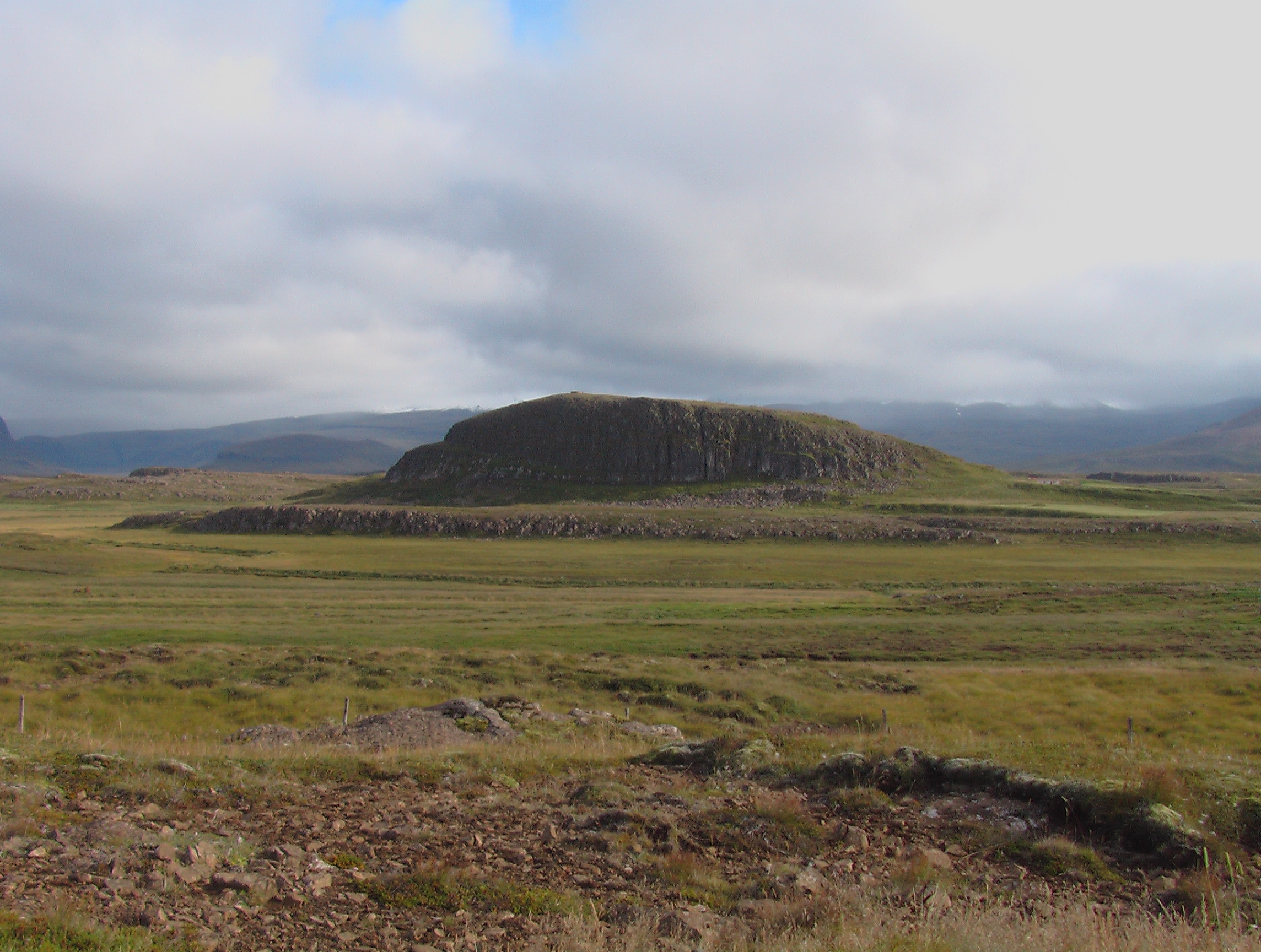 |
| Helgafell. Myths tell us this is the burial mound of the Icelandic heroine Guðrún Ósvífrsdóttir. It is venerated as a sacred place of peace and enlightenment: It was the birthplace of the historian Ari Thorgilsson the Learned and once held a library of knowledge. It is also, perhaps because of its resemblance to a house with a door, seen as a gateway to other worlds. |
What do we mean when we talk about Homeland? It's a question that has occupied my mind a lot this year. I was born and raised in Vermont and have spent my entire life here, but for the longest time I never considered myself a serious “Vermonter”, except by tautological default, largely because I guess I never knew what that really meant. Every place has a regional identity, and Vermont is no different, but “Vermonter” definitely means something special over here. It's just it took me awhile to figure out what that was, possibly because I've tended to be as isolated from my fellow Vermonters as much as I've been isolated from everyone else (not typically by choice, I hasten to add).
My parents moved here from Southwestern New York, bluntly, to hide. They wanted to be left alone and to be closer to the wilderness. Also though, I think they moved here because it reminded them of the United Kingdom and the British Isles, of which they're both enormous fans. There's a settlement on a mountain fifteen minutes away from me called New Ireland, and just beyond that is the stretch of land known as the Northshire, which is pretty much like what it sounds like it'd be like. They don't call this part of the United States New England just because it was the first place the pilgrims settled: There are parts of the Northeast US that would catch the eye of any Anglophile or visitor from across the pond. This all made sense to me. Until recently.
There are very few events I've lived through that I can decisively point to and say they conclusively changed my life. I can count them probably on half of one hand. Late 2010 into 2011 was a confluence of those events, including a chance meeting with a quirky and esoteric band of bloggers and Internet writers who would go on to become some of my closest friends and the first people I could comfortably and unhesitatingly call colleagues. But there are two important ones for the context of this piece: First was Vermont's behaviour in the 2010 midterm elections, in which a party of people advocating the state's secession from the United States and transformation into a anarcho-communist republic based around localist ideals blindsided everyone by walking away with a staggering 20% of the vote. They haven't made a lot of noise since, but our state has one of the most uniquely creative and progressive approaches to local politics you'll find anywhere in the US and is a natural breeding ground for that kind of thinking. This was the first time I realised how deathly serious we were about that. Vermont is one of the only places where the heart of the true and truly radical left still beats loudly in this country, and I suddenly realised I was a fit for this place.
But what actually is Vermont? I can't tell you objectively, as no-one can. But I'm sure my fellow Vermonters have a lot of strong opinions about it. I can, however, speak from my own personal experience. And I don't think Vermont is part of New England. I think it's something else. Whenever I spend time in Connecticut or Boston I don't really feel at home there. It doesn't feel like part of the same larger entity to me: It feels more like whenever I visit the Mid-Atlantic: It's close, both geographically and climatologically, and there's certainly a continuity, but it's not quite the same thing (no offense meant to my dear friends Phil and Maddy who do live in Connecticut and Boston, respectively: I'm sure they have just as complex feelings about where they live as I do). New Hampshire and Maine might be closer, but I still find them regionally distinct enough.
I'm not just talking about our quirky politics and local identity. There's an energy about this place I notice that I don't find everywhere. This year I read a wonderful book called Running with the Fairies which is an ethnography of the “Fairy Faith” in Ireland, which is in some ways an evolution of the earlier NordicXCelticXGermanic animism and folklore blended with bits of later Christian teachings. They use much the same language, saying that the Earth Magick, which they associate with the Fairies (who can be air or earth elementals) is stronger in some places than it is in others. The only other place I know I've felt a similar power or presence so far is, weirdly, Cape Cod, which is about as distinct from the rest of Massachusetts and New England as Vermont is...and almost as distinct from Vermont. Cape Cod is the place where the land disappears into sea and sky. The Outer Lands. It is, in the words of its greatest biographer, the Outermost, closer in kin to the Atlantic Ocean then to North America. It's also, funnily enough, probably the only other place in the US that has as staunchly radical, progressive and fiercely independent identity as we do. The exploits of Provincetown alone, at the very tip of the island, are legendary.
My parents always joke that I was born in the wrong part of the world. That I'm really a sea person who should move somewhere more tropical. It is true that I'm a surfer and subscribe to a lot of the beliefs and philosophies of the old surfers from Polynesia (not so much the commercialized glamour show of Southern California). I've had a fascination with that part of the world for years, and some of the first works that really captured my interest were nature documentaries about the ocean and movies like Disney's The Little Mermaid.
 |
| The Little Mermaid statue sits off the Langelinie boardwalk in Copenhagen, Denmark. |
Cape Cod, thanks to its unique location, has really bizarre weather patterns. It's in the North Atlantic, but it attracts plant and animal species more commonly found in subtropical and tropical coastal environments, typically as it's a convenient pit-stop during the migrations that happen in the leadup to every winter and summer. Thanks to deforestation and the harshness of the ocean, the entire island is now covered in a twisted, gnarled, dried-out blanket of pine barrens, which just makes the whole place feel rawer and more elemental.
Cape Cod is home to the Woods Hole Oceanographic Institute, at one time the leading such institute in the world. Doctor Robert Ballard was based there, and launched his expedition to find the wreck of the RMS Titanic from Woods Hole. I wrote him a fan letter once.
 |
| Skálholt map, showing Norse conception of the Americas. The Vikings told of settlements in a region of North America called Vinland, or "meadow-land" where there was no snow in winter. Some scholars have placed the settlement Kjalarnes at Cape Cod. |
The other event from 2010 and 2011 that changed the course of my life was the launch of The Elder Scrolls V: Skyrim. Skyrim is a serious contender for not just my favourite video game ever, but my favourite work of fiction period. But you should probably know that given the fact I can't seem to stop talking about it. I initially just picked up Skyrim simply to give the series one more shot: I'd played an Elder Scrolls game once before, The Elder Scrols IV: Oblivion, at the start of the seventh generation, but it failed to really grab me. I really liked the concept of an open-world action RPG where player choice and the freedom to explore, not just the sprawling world but your own individual experience of the world, was paramount. But the Cyrodiil of Oblivion did nothing for me: It was one big expanse of identical green fields that was the setting for what seemed to me to be a generic rip-off of J.R.R. Tolkien. I didn't know anything about what The Elder Scrolls' Tamriel really meant. Skyrim fixed that for me.
At the beginning of Skyrim, just as in the beginning of any RPG, you're asked to design a character. The Elder Scrolls gives you a choice of eight possible races and two genders: Knowing next to nothing about the background lore of the series I arbitraily made my character a female Nord, as I knew Skyrim took place in their homeland and the player was supposed to be hero of Nordic mythology. It made sense at the time. I gave her a name that was a variation on the name of the heroine of Jan Brett's book The Wild Christmas Reindeer, a story I remembered once enjoying about a spirited stablehand who herds Santa's reindeer. Brett has written many other books set in Scandinavia and the other real-world Nordic countries, and I always appreciate how her meticulous illustrations convey the worlds of the far North she seems to love so much so well.
 |
| Desktop wallpaper by Artfall, based on concept art for The Elder Scrolls V: Skyrim. |
If you're as unfamillair with The Elder Scrolls as I was when I first started Skyrim you would be forgiven for thinking the Nords are simply a stand-in for the Vikings, in particular the generic barbarian Vikings so common to fantasy stories. Start to pay attention to the game a bit more though and you'll find that's not really the case: None of the races in Tamriel have direct real-world parallels. They all draw upon many different cultures, myth cycles and belief systems to create an identity that's at once unique to The Elder Scrolls and also very logical extrapolations and exaggerations of real world patterns of human migration. While the Nords do in many ways resemble Vikings, they're actually far closer to what we know of the pre-Christian, pre-Norse GermanicXCelticXNordic inhabitants of northern Europe and also seem based quite heavily on ancient Egyptians, the Stone Age Megalith builders and, especially in the case of the Skaal (an isolated group of Nords living on the far northern island of Solstheim between Skyrim and Morrowind), the animistic shaman beliefs of the idigenous peoples of the Americas, the Inuit, the First Nations of Canada and the Sami of the Nordic countries.
Very quickly my choice to play a Nord became a retroactive no-brainer. As I was gradually drawn more and more into the game's world I started to feel as connected to the land of Skyrim as its own people do. Skyrim, as a place, means a lot to me now, as much as any real-world “homeland” might. I am still religiously playing the game nearly two years after it was released and have, as of this writing, clocked a little under a thousand hours into just my PC copy. I probably know my way around Skyrim better than I do a lot of real places, and I hardly ever use the game's fast travel feature anymore. I know exactly where I'm going, and I love the land so much I need to experience as much of it as I can. But that's the thing about lands like Skyrim: They are real places: The Tamrielic monomyth tells us the world came into being by the intersection of the primordial forces of Order and Chaos, of Stasis and Change, in the Dreamtime. Chaos traumatically inspires Order to create, and Order creates by lucid dreaming of Creation. Skyrim, like everywhere in Tamriel, is a world built around ideas and dreams and given life by its people, who are all dreaming of it.
 |
| Skyrim, goodmorning by Jorian89. Skyrim the way we see it. |
One thing the Nords share with many of their Elven counterparts (though they'd never admit it given the longstanding hostility between humans and Mer) is their fixation on what has been described as a process of mythogeneosophy: A Sacred Geneaology that traces their lineage back to the Dawn Times. The primary difference between them and their enemies the Altmer is that the Nords much prefer mutable oral history to staunch objective, obsessively curated records. A Master Narrative for a people who have a troubling tendency to fancy themselves a Master Race. The Nords, by contrast, turn to their history and myths as guidance for how to live their lives day to day, and minor things like “historical accuracy” (if such a thing can every really truly exist) are acceptable casualties if the alternative is giving up a good story that might could help shed new light and new perspectives on whatever current crisis they might be facing. We frequently turn to our heroes, idols, role models and the stories we heard as children in the hope they might help us come to terms with adulthood, and in the process we constantly re-interpret them.
Lewis Carroll always felt children (though really, girls) had a kind of perspective worth holding onto throughout life. Not the blissful naivete of children per se, but more the sense that the world is a grand and wondrous place and that some form of appreciation and acceptance of this makes us happier and healthier, a perspective shared by Shigeru Miyamoto. Maybe that's why we still turn to supposed children's literature like Carroll's Alice in Wonderland diptych, or Miyamoto's Super Mario games...and why works like those are frequently deeper and more meaningful than about 95% of the stuff targeted towards adults. Of course there's no way I could ignore the Once and Future Underqueen on her summoning-day: There's no way she would allow this, and the Dreamtime's Chessmaster checkmates again. As she always does. As she always will.
|

I've always felt a kind of kinship with Canada as a whole, though I've never really been consciously aware of it until recently. I'm closer to Canada than I am to a lot of the United States, and in perhaps more than just a geographic sense. In the 1990s one of the only other television series I made a point to watch whenever I came on apart from Star Trek or Scooby-Doo was Acorn the Nature Nut, hosted by Alberta-based entomologist John Acorn. Like the Kratts and Gisèle Benoit, John Acorn was another naturalist on whom I based my conception of nature. Acorn was also known for his distinctive dry, understated tongue-in-cheek humour also shared by The Arrogant Worms, one of my favourite music acts, and that has been described as distinctly Canadian. I've sometimes been told I have a similar sense of humour. One of my favourite TV shows now is still Survivorman, hosted by Ontario native Les Stroud. What intrigues me the most about Survivorman isn't so much the survival techniques Stroud is ostensibly teaching us, but how intimate he seems to become with the land when he's alone in the wilderness for seven days. The show is as much about our connection to nature and our natural roots as much as it is about what to do if you crash your bike in the Canyonlands in the middle of winter (this is, incidentally, what's missing from not just every other survival show, but every other contemporary nature show period).
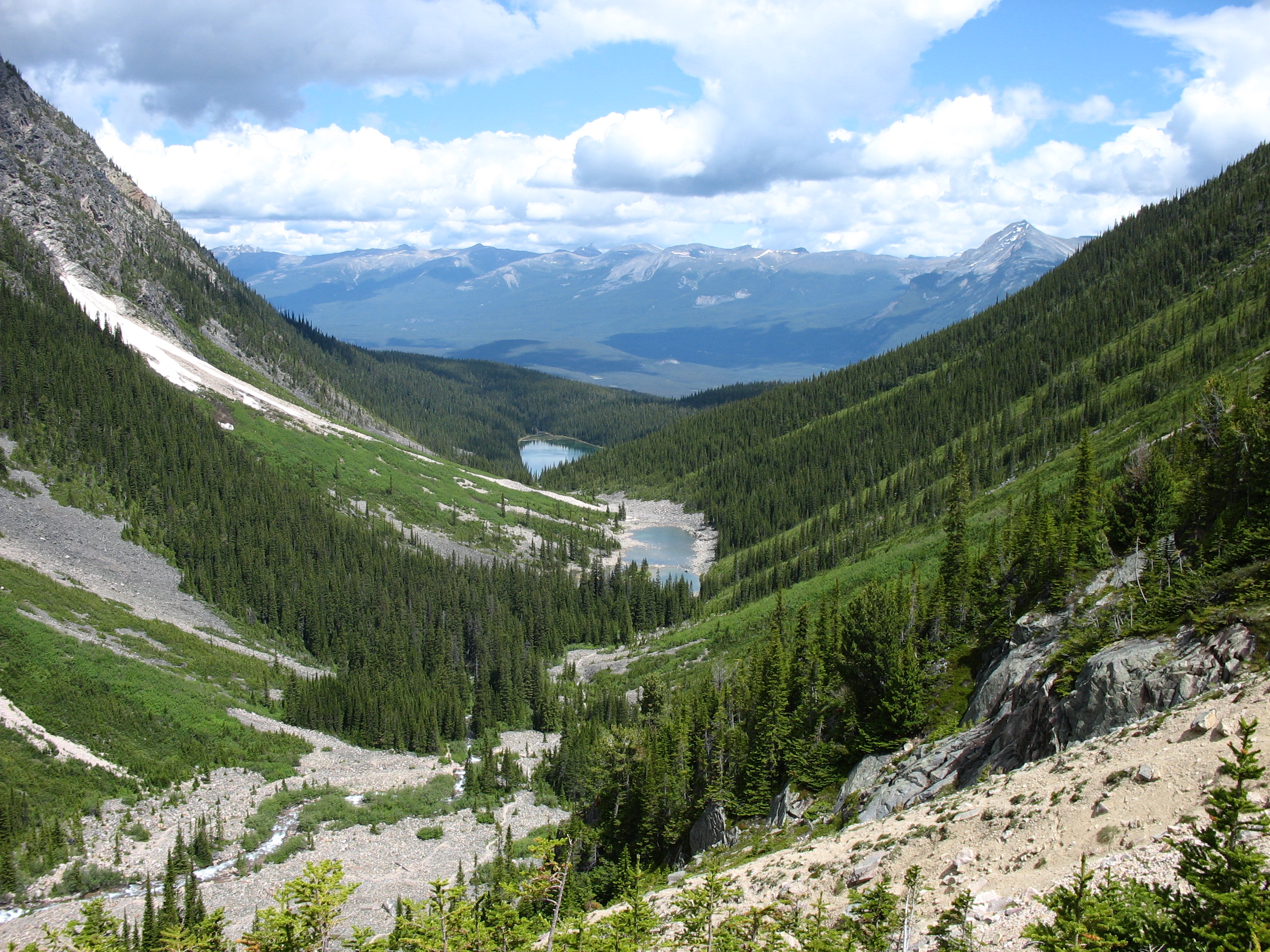 |
| Athabasca River Valley, Alberta, as seen from the Geraldine Lakes. The Athabasca River is mentioned in the Arrogant Worms song "The Last Saskatchewan Pirate", and greatly reminds me of Skyrim's soaring mountains and winding valleys. |
 |
| Cascapédia sous la neige, by Gisèle Benoit. |
Every once in awhile I'll cross the border into New York with my family. This is largely because if we need to get any substantial shopping done, it's impossible to do that where we live. On the highway coming out of the border town of Bennington and leading towards Albany, there's a ridiculous tourist trap of a place called the Big Moose Deli just across the state line. It advertises itself as “the last stop in New York” and the place to go if you want to stock up on “Vermont Gifts” and souvenir kincknacks. And yes, there is in fact a gold-painted moose on the roof of the building. That and every kind of gaudy, tawdry eyesore you can think of piled up as far as the eye can see in the parking lot. Sadly, it's but one of many such institutions you find as soon as you enter the Mid-Atlantic (though it's probably the worst). Vermont is one of the only four states in the country where roadside billboards and advertising are expressly forbidden (the others being Alaska, Maine and Hawaii) and you don't need a “Welcome to New York” sign to let you know you've crossed over.
My family and I have debated on numerous occasions what precisely the purpose of the Big Moose Deli is. Do tourists think Vermont is one big empty expanse of forests and mountains and that the Big Moose Deli is the last bastion of civilization they'll bear witness to before boldly plumbing the heart of the wilderness? I mean, people do live here, and we can probably sell you better maple syrup, barbecue and handmade crafts. I suppose it is one of the highest profile places between the tri-city area and the ski resort communities if you don't ever leave the highway, and the Big Moose Deli enthusiastically sells itself as the “Gateway to Vermont”.
But that got me thinking that maybe Vermont is a kind of gateway itself: A Gateway to the North. Part of what makes us distinct is that our mountains are known as the Green Mountains, because they're heavily forested instead of rocky. But also I think it's because of our abundance of conifers when compared to the rest of the Northeast US. Climatologically speaking, Vermont is the gradient between two biomes: The mixed broadleaf forests characteristic of southern New England (excepting Cape Cod) and the taiga of Canada. The Boreal Forest. Ironic for a state famous for autumn leaf-watching tourism, the further north you go the more pines you see (and the fewer deciduous trees) and the more and more Vermont starts to look like a proper Northland. Vermont is the space between.
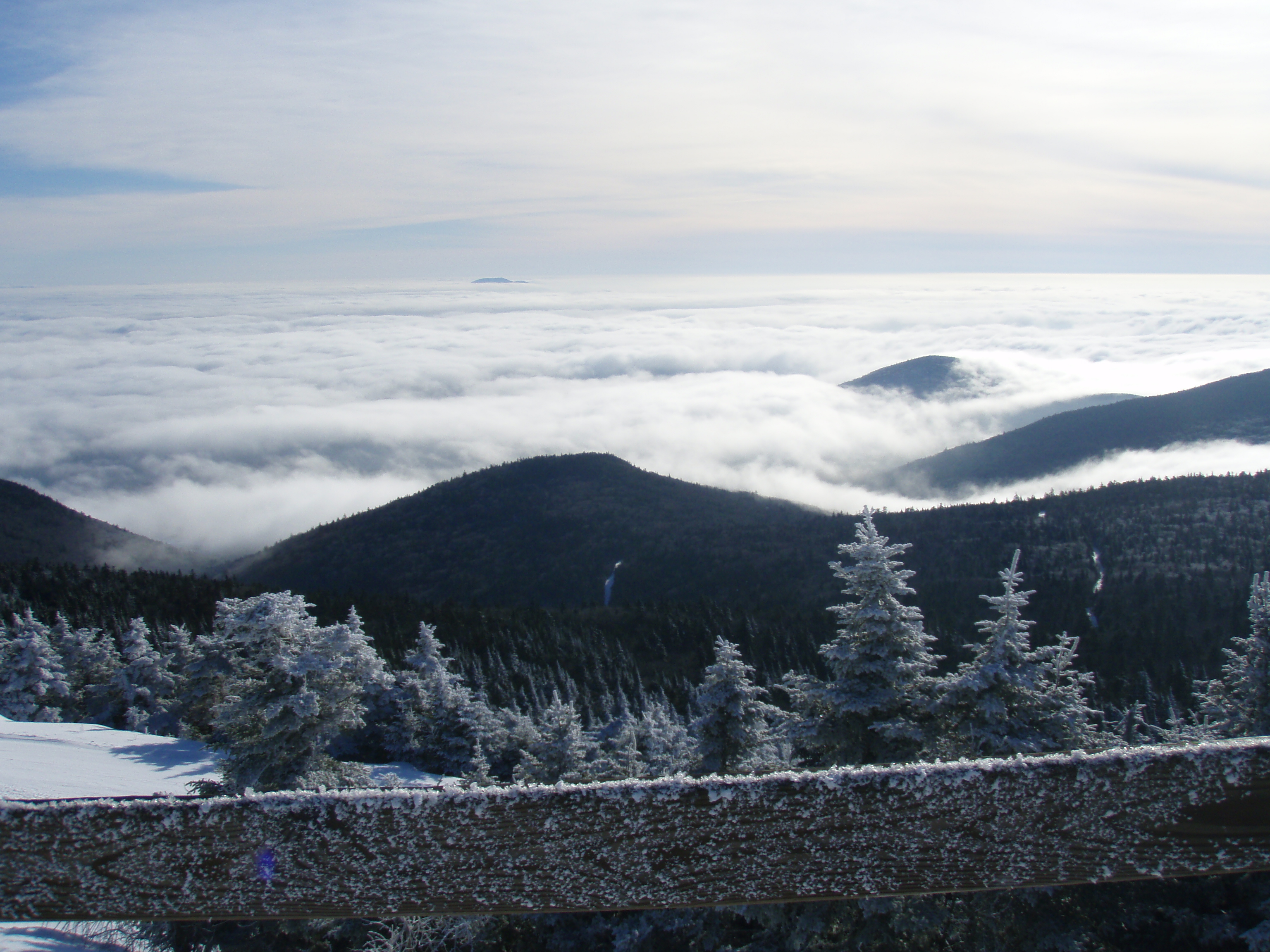 |
| View from the summit of Killington Peak, home of Killington resort. Nicknamed "The Beast of the East", Killington is one of the largest and most challenging descents on the eastern seaboard. Nowadays, it also incorporates the resort at Pico, its neighbouring mountain. Pico is the oldest ski resort in Vermont, founded in 1937 by the Meads, a family of Norwegian immigrants. Daughter Andrea was an Olympic gold medalist. Pico can be seen in the distance. |
The closest Canadian province to me is Québec, and I do now wonder how much being so nearby has shaped my positionality. I'm far enough north to feel closer to my neighbours in Canada than to my neighbours in New England or the Mid-Atlantic. In many ways I now consider myself a true Northerner. That said, I'm also far enough south to be disconnected from the sociopolitical machinations of the province, which, given Québec's staunchly and infamously nativist and racist history is probably a good thing. Québec is also where Gisèle Benoit's legal residence is, though the fact she spends most of her time distant and removed from human society in the forests of Cascapédia leads me to wonder how connected she feels to the strife and upheaval going on around her. We were all Wandering Ehlnofey in the Dreamtime. It was the Old Ehlnofey who turned to isolationism, but they did so out of insular, incestuous xenophobia, not a desire to become close to the land and the sky. It was the Wanderers who settled in Alt Mora, the Elder Wood, who learned how to do that.
 |
| Concept art for Elise Riggs from the 2012 reboot of SSX. Elise (played by Lucy Liu in SSX Tricky) is a Canadian snowboarder, surfer and base jumper. She's one of my biggest idols and role models. One of my favourite levels in the original SSX Tricky is called "Aloha Ice Jam" and is set on a glacier that's been towed from the arctic to Hawai'i. |
In talking about the Alice in Wonderland diptych, Martin Gardner (who, in spite of the numerous problems he had in regard to his scholarship and motives in his other fields and careers, probably remains the foremost authority on Lewis Carroll) once mused on the irony of the mathematician and Reverand Charles Dodgson becoming most famous for his “pagan nonsense”. Gardner was most likely talking about how curious it was for the formative work of Victorian children's literature, and really all children's literature, to have nothing to do with Christianity, or really Westernism in general (indeed, its status as one-part venomously barbed social satire makes it rather the opposite of those things), but I'm going to take him literally. Alice is a pagan queen.
While Alice in Wonderland is very British, it's most evocative of the parts of British culture that predate the arrival of Westerners: All the references to the sídhe, (and to Elves in the working title) and to Otherworlds (including, debatably, Tír na nÓg) make this rather self-evident. It's also quite critical of the parts of Victorian Britain that come out of Westernism, most notably its attitude towards royalty: Gardner describes Carroll as a Tory royalist, but he's always seemed more ambivalent on this front to me and illustrator John Tenniel, a famous polticial cartoonist at the time, certainly seems less enamoured with the whole prospect. Either way, with or without Carroll's and Tenniel's positionalities, it's perfectly easy to afford the work this reading, and I'm not the first to do so.
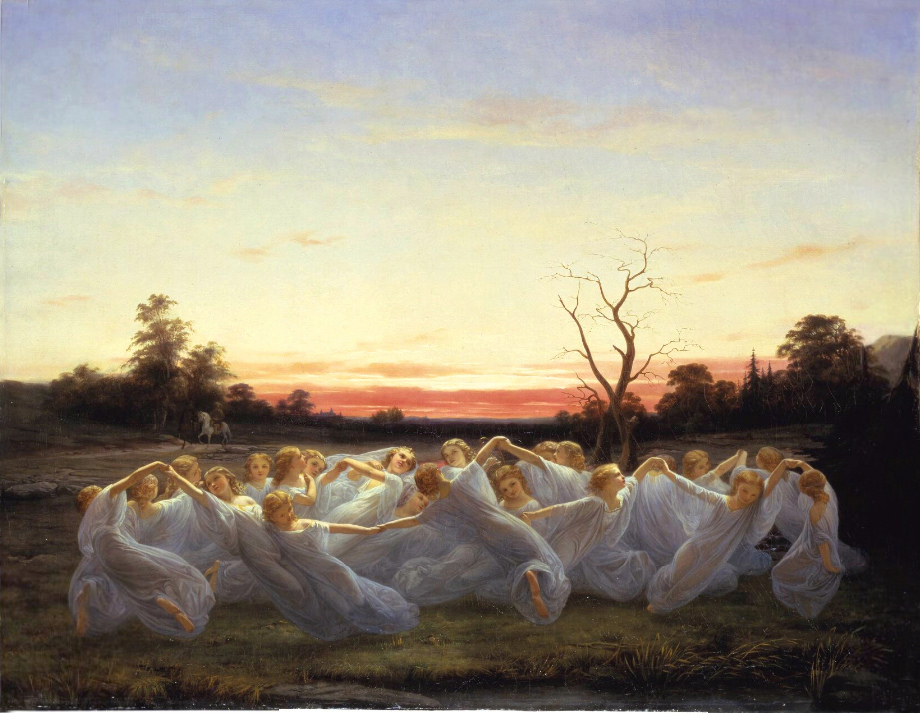 |
| Meadow Elves, by Nils Blommér, depicts a gathering of Light Elves from Álfheimr, one of the nine worlds of Norse mythology. It is said Elves, like all spirits, would gather to dance on the hills during the festivals of Beltane, Midsummer and Samhain. |
One of the things that's most impressed me about the history of the Tamrielic Nords is how logical and sensible it actually sounds. While, as I said, the Tamrielic races have no explicit real-world analogues its tough not to spot the influences in Nordic culture. They're Northerners, and it was through The Elder Scrolls I was finally able to come up with a theory about what that might mean. The Nords, the original Nords from Atmora, not the ones who absorbed too much influence from the Cyrodiilic empire and the Dragons they once revered, were mystical, animistic shamans for whom living as harmoniously with the land as was possible was a virtue of paramount importance, and they worshiped the sky as the domain of deified ancestors, and to understand all of this was to understand enlightenment. These are traits the Tamrielic Nords very overtly share with real-life Northerners: It's a cultural model shared by the Indigenous Americans, the Inuit, the Sami, and the real-life pre-Christian, pre-Norse Nordic peoples, and it decisively sets them apart from Westerners: These people are far more similar to each other than they are to those who originated from France, Italy, Spain and Greece. And its to them who I feel I might share a strong kinship with as well.
 |
| Fanart by Rafaken of the Throat of the World, the mountain serving as the symbolic and literal centre of the land of Skyrim. Also debatably the tallest peak in Tamriel. It is said the snow on the Throat of the World cannot melt, and dates back to the Dawn Times. The Nords believe humans were created when Kyne, wife of Shor, breathed life upon its peak. Nowadays, the renegade Dragon Paarthurnax, leader of the the Greybeards (a pacifist order of Nordic monks who devote their lives to worship of the Sky), meditates here on the concept of Voice, and how it can be used to touch divinity. |
I suppose this would raise the question of how I reconcile my newfound Northerner heritage with my pre-existing magnetic attraction to the ocean, especially the tropical Pacific. In Norse mythology, Skaði, the Jötunn goddess of winter, skiing and the mountains was once married to Njörd, the god of the sea. While together, they split their time evenly between their two realms, with Skaði spending half the year with her husband in the ocean and Njörd spending the other half with his wife in the mountains. But neither was happy with this arrangement, and each would long for home while away from it, so they eventually divorced. But, strangely enough, I find the people the Northerners are most similar to may actually be the Polynesians.
 |
| In Donkey Kong Country 3: Dixie Kong's Double Trouble! and its sequel Donkey Kong Land III, Dixie Kong travels to the "Northern Kremisphere", a Northlands-inspired environment south of tropical Donkey Kong Island, eventually discovering the "Lost World", spoken of in myth and legend. The Northern Kremisphere, much like the Kongs' homeland, features tropical jungles intermixed with snow-capped mountains. The Donkey Kong Land series was one of my first real video game loves. Dixie Kong returns in 2014 in the WiiU sequel Donkey Kong Country: Tropical Freeze, by Retro Studios (known for Metroid Prime) and which features Vikings landing on Donkey Kong Island. |
Both groups have similar attitudes towards oral history and both revere deified ancestors and elemental spirits. Most critically though, both placed great importance on the interconnectedness of worlds, in particular that of human life with the nature, as they are ultimately one and the same. Both also felt tied to their lands in a very deep and meaningful way-It's just the Poylnesians' “land” was in fact the Pacific Ocean. Indeed, both the Polynesians and the Norse Vikings were exquisite navigators (though the Polynesians were unquestionably superior): In fact, Te Rangi Hīroa's landmark ethnographic history of the Polynesians was titled Vikings of the Sunrise...and was cited by H.R. Ellis Davidson in her comparative analysis of the Celtic, Norse, German and Nordic peoples Myths and Symbols in Pagan Europe: Early Scandinavian and Celtic Religions.
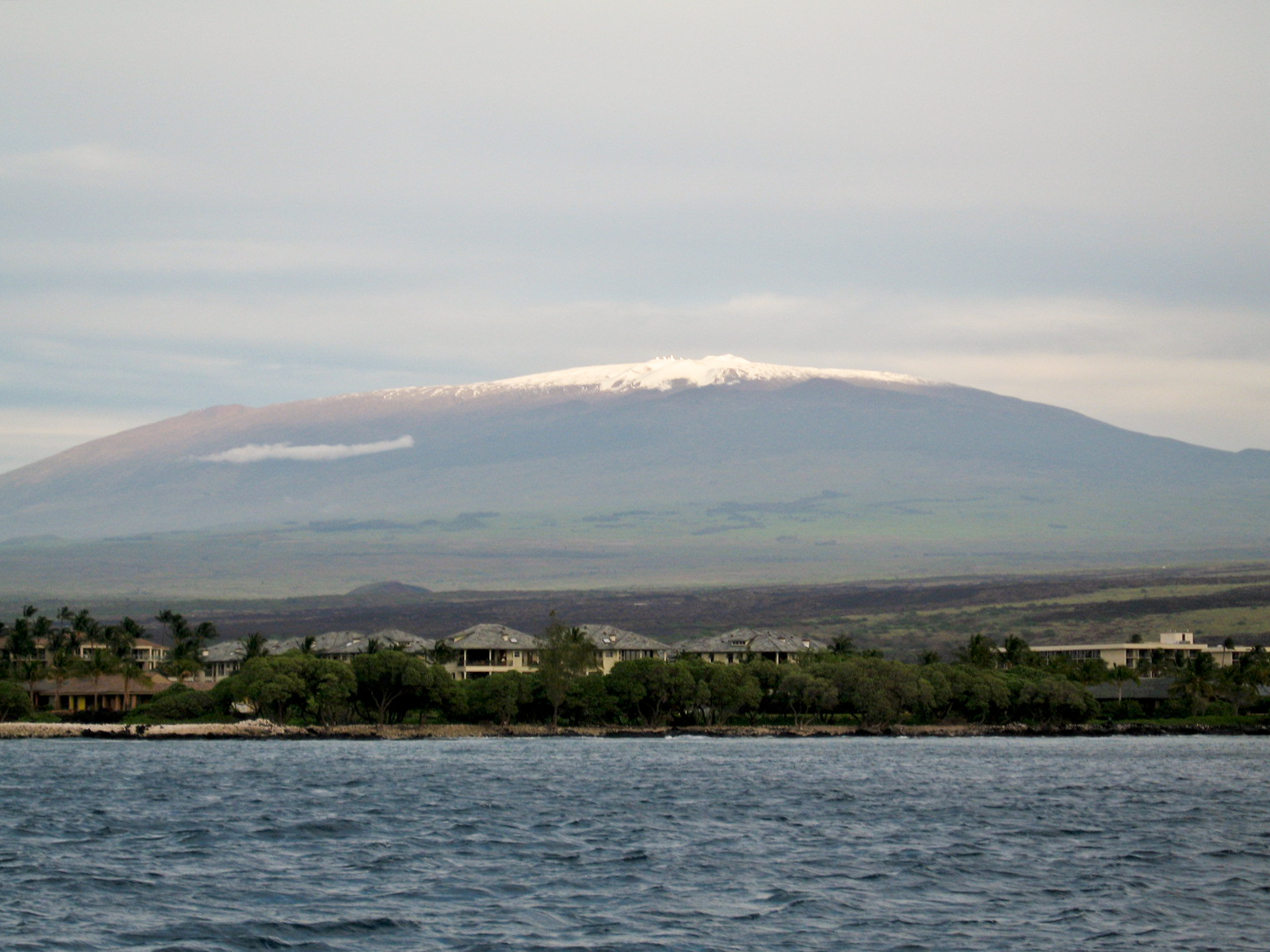 |
| Mauna Kea, as seen from the Ocean. The tallest peak in Hawai'i. Known as Mauna o Wākea, literally "The mountain of Wākea" in the Ancient Hawaiian, and seen as the land of the Gods, home of kind and helpful spirits, the seat of the sky deity Wākea and realm of Poliʻahu, goddess of snow. |
I suppose I exist between extremes, or perhaps more accurately where extremes intersect. The Celts divided their year into a light half and a dark half, but it was the in-between times, when both light and dark comingle, that was the most sacred to them. I've never much cared for Fall. Actually, I loathe it. I much prefer Summer and Winter. Like the spirits, I celebrate midsummer and midwinter, but I'm most energized at Samhain and Beltane when summer and winter begin and end and coexist simultaneously. That's when I come alive.
 |
| Concept art for Tundraful, the second level of Alice: Madness Returns-American McGee's (of id Software fame) Gothic and surrealist re-interpretation of Alice in Wonderland. |
May 4: The Dream-Child takes the Walking Way and learns to Dream.
November 4: The Dreamer Dreams anew, and henceforth Dream becomes Dreamer.
May 4: The Walking Ways lead us to the Mountain, upon which we may touch the sky.
November 4:
SummerXWinter. LightXDark. SeaXSky. These are the names of the Looking-Glass that we find at the turning of the year. The In-Between days remind us that such things are universes apart brought together at the World Tree, the I. Dreamers of Godhood within the Dream of Godhead. We exist at the point between opposite extremes where opposite extremes exist together within themselves. The Mirror-Globe reflects images of ourselves and our own future-past. And so it all begins again.
May 4: Taika, who is Ysmir Storm-Crown, returns as Adaleiz, born Adalhaidis of Atmora.
 |
| Snowgirl repainted, by Yoggurt. |
“Tamriel never belonged to Bethesda. It was the other way around.
As for canon, it's really all interactive fiction, and that should mean something to everyone. That said, I appreciate and understand the stamp of 'official', but I think it will hurt more that it will help in the long run.
TES should be Open Source. It is for me.”
-Michael Kirkbride


