Showing posts with label Nintendo. Show all posts

Monday, November 4, 2013

Frostfall

Goddess On The Mountain by Liquidd-1

May 4: Born on the first breath of summer, the Dream-Child finds the Walking Way.

November 4: The crown is seized for the Empire of One, bringer of summer to winter.

May 4: The Woman-Goddess convenes the Summit on the Mountain and touches the Sky.

November 4:


Birth and Death and Order and Chaos are two sides of the Looking-Glass that intersect at the turning of the year. The In-Between days remind us that such things are universes apart brought together at the World Tree, the I. Dreamers of Godhood within the Dream of Godhead. We exist at the point between opposite extremes where opposite extremes exist together within themselves. The Mirror-Globe reflects images of ourselves and our own future-past. And so it all begins again.
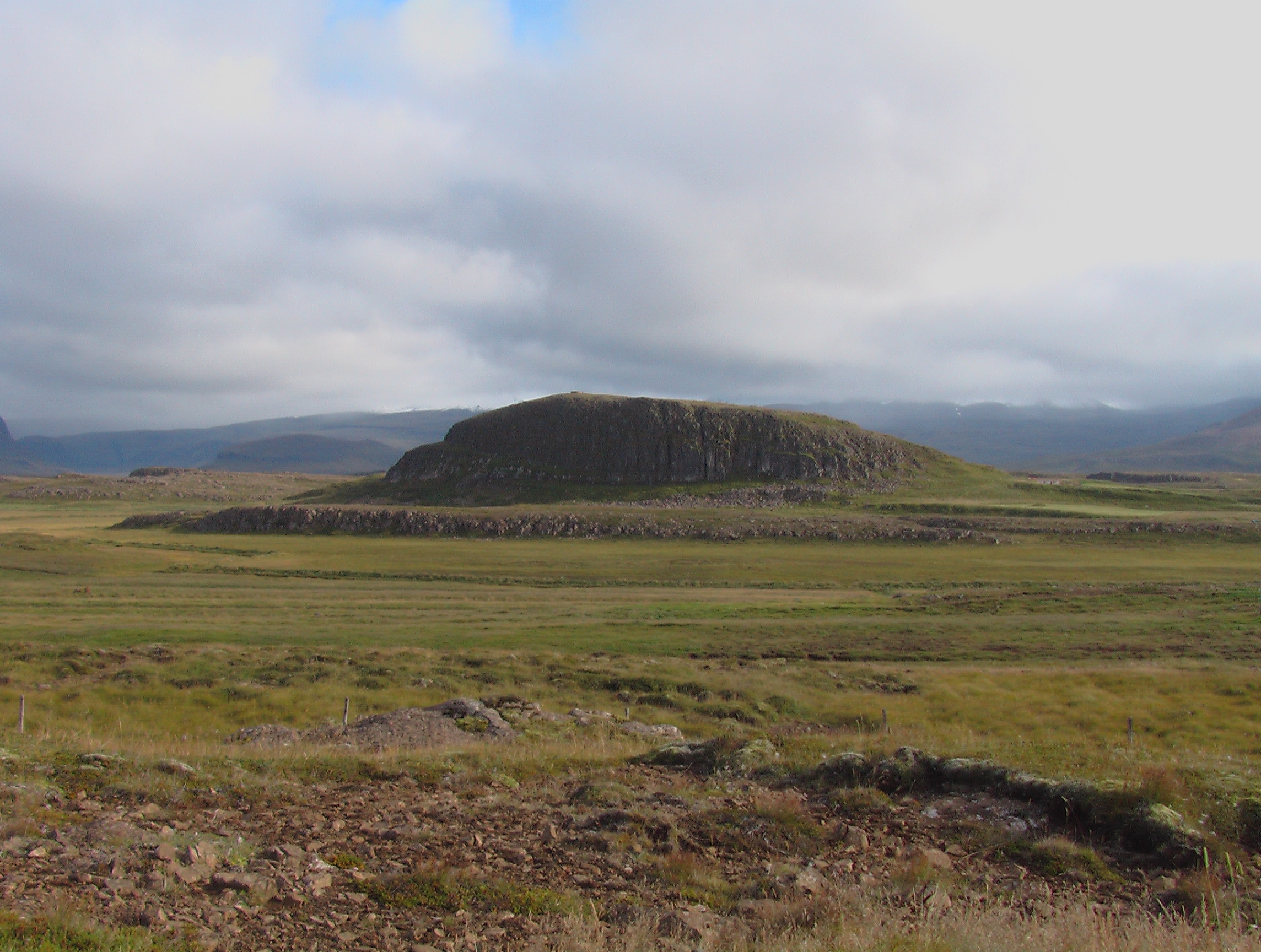
Helgafell. Myths tell us this is the burial mound of the Icelandic heroine Guðrún Ósvífrsdóttir. It is venerated as a sacred place of peace and enlightenment: It was the birthplace of the historian Ari Thorgilsson the Learned and once held a library of knowledge. It is also, perhaps because of its resemblance to a house with a door, seen as a gateway to other worlds.

What do we mean when we talk about Homeland? It's a question that has occupied my mind a lot this year. I was born and raised in Vermont and have spent my entire life here, but for the longest time I never considered myself a serious “Vermonter”, except by tautological default, largely because I guess I never knew what that really meant. Every place has a regional identity, and Vermont is no different, but “Vermonter” definitely means something special over here. It's just it took me awhile to figure out what that was, possibly because I've tended to be as isolated from my fellow Vermonters as much as I've been isolated from everyone else (not typically by choice, I hasten to add).

My parents moved here from Southwestern New York, bluntly, to hide. They wanted to be left alone and to be closer to the wilderness. Also though, I think they moved here because it reminded them of the United Kingdom and the British Isles, of which they're both enormous fans. There's a settlement on a mountain fifteen minutes away from me called New Ireland, and just beyond that is the stretch of land known as the Northshire, which is pretty much like what it sounds like it'd be like. They don't call this part of the United States New England just because it was the first place the pilgrims settled: There are parts of the Northeast US that would catch the eye of any Anglophile or visitor from across the pond. This all made sense to me. Until recently.

There are very few events I've lived through that I can decisively point to and say they conclusively changed my life. I can count them probably on half of one hand. Late 2010 into 2011 was a confluence of those events, including a chance meeting with a quirky and esoteric band of bloggers and Internet writers who would go on to become some of my closest friends and the first people I could comfortably and unhesitatingly call colleagues. But there are two important ones for the context of this piece: First was Vermont's behaviour in the 2010 midterm elections, in which a party of people advocating the state's secession from the United States and transformation into a anarcho-communist republic based around localist ideals blindsided everyone by walking away with a staggering 20% of the vote. They haven't made a lot of noise since, but our state has one of the most uniquely creative and progressive approaches to local politics you'll find anywhere in the US and is a natural breeding ground for that kind of thinking. This was the first time I realised how deathly serious we were about that. Vermont is one of the only places where the heart of the true and truly radical left still beats loudly in this country, and I suddenly realised I was a fit for this place.

But what actually is Vermont? I can't tell you objectively, as no-one can. But I'm sure my fellow Vermonters have a lot of strong opinions about it. I can, however, speak from my own personal experience. And I don't think Vermont is part of New England. I think it's something else. Whenever I spend time in Connecticut or Boston I don't really feel at home there. It doesn't feel like part of the same larger entity to me: It feels more like whenever I visit the Mid-Atlantic: It's close, both geographically and climatologically, and there's certainly a continuity, but it's not quite the same thing (no offense meant to my dear friends Phil and Maddy who do live in Connecticut and Boston, respectively: I'm sure they have just as complex feelings about where they live as I do). New Hampshire and Maine might be closer, but I still find them regionally distinct enough.

I'm not just talking about our quirky politics and local identity. There's an energy about this place I notice that I don't find everywhere. This year I read a wonderful book called Running with the Fairies which is an ethnography of the “Fairy Faith” in Ireland, which is in some ways an evolution of the earlier NordicXCelticXGermanic animism and folklore blended with bits of later Christian teachings. They use much the same language, saying that the Earth Magick, which they associate with the Fairies (who can be air or earth elementals) is stronger in some places than it is in others. The only other place I know I've felt a similar power or presence so far is, weirdly, Cape Cod, which is about as distinct from the rest of Massachusetts and New England as Vermont is...and almost as distinct from Vermont. Cape Cod is the place where the land disappears into sea and sky. The Outer Lands. It is, in the words of its greatest biographer, the Outermost, closer in kin to the Atlantic Ocean then to North America. It's also, funnily enough, probably the only other place in the US that has as staunchly radical, progressive and fiercely independent identity as we do. The exploits of Provincetown alone, at the very tip of the island, are legendary.

My parents always joke that I was born in the wrong part of the world. That I'm really a sea person who should move somewhere more tropical. It is true that I'm a surfer and subscribe to a lot of the beliefs and philosophies of the old surfers from Polynesia (not so much the commercialized glamour show of Southern California). I've had a fascination with that part of the world for years, and some of the first works that really captured my interest were nature documentaries about the ocean and movies like Disney's The Little Mermaid.
The Little Mermaid statue sits off the Langelinie boardwalk in Copenhagen, Denmark.


Cape Cod, thanks to its unique location, has really bizarre weather patterns. It's in the North Atlantic, but it attracts plant and animal species more commonly found in subtropical and tropical coastal environments, typically as it's a convenient pit-stop during the migrations that happen in the leadup to every winter and summer. Thanks to deforestation and the harshness of the ocean, the entire island is now covered in a twisted, gnarled, dried-out blanket of pine barrens, which just makes the whole place feel rawer and more elemental.

Cape Cod is home to the Woods Hole Oceanographic Institute, at one time the leading such institute in the world. Doctor Robert Ballard was based there, and launched his expedition to find the wreck of the RMS Titanic from Woods Hole. I wrote him a fan letter once.

Skálholt map, showing Norse conception of the Americas. The Vikings told of settlements in a region of North America called Vinland, or "meadow-land" where there was no snow in winter. Some scholars have placed the settlement Kjalarnes at Cape Cod.

The other event from 2010 and 2011 that changed the course of my life was the launch of The Elder Scrolls V: Skyrim. Skyrim is a serious contender for not just my favourite video game ever, but my favourite work of fiction period. But you should probably know that given the fact I can't seem to stop talking about it. I initially just picked up Skyrim simply to give the series one more shot: I'd played an Elder Scrolls game once before, The Elder Scrols IV: Oblivion, at the start of the seventh generation, but it failed to really grab me. I really liked the concept of an open-world action RPG where player choice and the freedom to explore, not just the sprawling world but your own individual experience of the world, was paramount. But the Cyrodiil of Oblivion did nothing for me: It was one big expanse of identical green fields that was the setting for what seemed to me to be a generic rip-off of J.R.R. Tolkien. I didn't know anything about what The Elder Scrolls' Tamriel really meant. Skyrim fixed that for me.

At the beginning of Skyrim, just as in the beginning of any RPG, you're asked to design a character. The Elder Scrolls gives you a choice of eight possible races and two genders: Knowing next to nothing about the background lore of the series I arbitraily made my character a female Nord, as I knew Skyrim took place in their homeland and the player was supposed to be hero of Nordic mythology. It made sense at the time. I gave her a name that was a variation on the name of the heroine of Jan Brett's book The Wild Christmas Reindeer, a story I remembered once enjoying about a spirited stablehand who herds Santa's reindeer. Brett has written many other books set in Scandinavia and the other real-world Nordic countries, and I always appreciate how her meticulous illustrations convey the worlds of the far North she seems to love so much so well.

Desktop wallpaper by Artfall, based on concept art for The Elder Scrolls V: Skyrim.

If you're as unfamillair with The Elder Scrolls as I was when I first started Skyrim you would be forgiven for thinking the Nords are simply a stand-in for the Vikings, in particular the generic barbarian Vikings so common to fantasy stories. Start to pay attention to the game a bit more though and you'll find that's not really the case: None of the races in Tamriel have direct real-world parallels. They all draw upon many different cultures, myth cycles and belief systems to create an identity that's at once unique to The Elder Scrolls and also very logical extrapolations and exaggerations of real world patterns of human migration. While the Nords do in many ways resemble Vikings, they're actually far closer to what we know of the pre-Christian, pre-Norse GermanicXCelticXNordic inhabitants of northern Europe and also seem based quite heavily on ancient Egyptians, the Stone Age Megalith builders and, especially in the case of the Skaal (an isolated group of Nords living on the far northern island of Solstheim between Skyrim and Morrowind), the animistic shaman beliefs of the idigenous peoples of the Americas, the Inuit, the First Nations of Canada and the Sami of the Nordic countries.

Very quickly my choice to play a Nord became a retroactive no-brainer. As I was gradually drawn more and more into the game's world I started to feel as connected to the land of Skyrim as its own people do. Skyrim, as a place, means a lot to me now, as much as any real-world “homeland” might. I am still religiously playing the game nearly two years after it was released and have, as of this writing, clocked a little under a thousand hours into just my PC copy. I probably know my way around Skyrim better than I do a lot of real places, and I hardly ever use the game's fast travel feature anymore. I know exactly where I'm going, and I love the land so much I need to experience as much of it as I can. But that's the thing about lands like Skyrim: They are real places: The Tamrielic monomyth tells us the world came into being by the intersection of the primordial forces of Order and Chaos, of Stasis and Change, in the Dreamtime. Chaos traumatically inspires Order to create, and Order creates by lucid dreaming of Creation. Skyrim, like everywhere in Tamriel, is a world built around ideas and dreams and given life by its people, who are all dreaming of it.


Skyrim, goodmorning by Jorian89. Skyrim the way we see it.

One thing the Nords share with many of their Elven counterparts (though they'd never admit it given the longstanding hostility between humans and Mer) is their fixation on what has been described as a process of mythogeneosophy: A Sacred Geneaology that traces their lineage back to the Dawn Times. The primary difference between them and their enemies the Altmer is that the Nords much prefer mutable oral history to staunch objective, obsessively curated records. A Master Narrative for a people who have a troubling tendency to fancy themselves a Master Race. The Nords, by contrast, turn to their history and myths as guidance for how to live their lives day to day, and minor things like “historical accuracy” (if such a thing can every really truly exist) are acceptable casualties if the alternative is giving up a good story that might could help shed new light and new perspectives on whatever current crisis they might be facing. We frequently turn to our heroes, idols, role models and the stories we heard as children in the hope they might help us come to terms with adulthood, and in the process we constantly re-interpret them.

Lewis Carroll always felt children (though really, girls) had a kind of perspective worth holding onto throughout life. Not the blissful naivete of children per se, but more the sense that the world is a grand and wondrous place and that some form of appreciation and acceptance of this makes us happier and healthier, a perspective shared by Shigeru Miyamoto. Maybe that's why we still turn to supposed children's literature like Carroll's Alice in Wonderland diptych, or Miyamoto's Super Mario games...and why works like those are frequently deeper and more meaningful than about 95% of the stuff targeted towards adults. Of course there's no way I could ignore the Once and Future Underqueen on her summoning-day: There's no way she would allow this, and the Dreamtime's Chessmaster checkmates again. As she always does. As she always will.


Alice by Antichristofer is a similar interpretation of the Underqueen and her realm to mine. To me, this version of Wonderland bears an uncanny resemblance to Morrowind. Using DeviantArt's "Browse More Like This" feature on this picture gave me fanart for The Elder Scrolls V: Skyrim.
A long time ago, perhaps as many as two decades, I once watched a nature documentary about a woman who lived alone deep within the Boreal Forest of Canada. She was fascinated by the lives of the local moose (known as Elk outside North America) and spent her days trying to join their community and painting gorgeously elabourate portraits of scenes of taiga life. I don't recall much about that special, though I remember the lady's name vividly: Gisèle Benoit. The idea of studying animals from a cultural perspective has always fascinated me. It dates back to the earliest forms of naturalism, back before, like all life sciences, it was subsumed by and folded into the monolithic engines of celular biology and neuroscience. From a zoology perspective this is often called ethology, although it's in many ways actually closer to ethnography and the Kratt Brothers (another team of modern-day naturalists who were big inspirations on my relationship with wildlife) call it “Creature Adventuring”. In fact, this is the primary reason I'm such a big fan of the Pokémon franchise, and what was going to be the philosophical underpinning of the multipart retrospective on that series that's supposed to be here. This was also the primary reason I abandoned the natural sciences to pursue anthropology instead. Years later, Donna Haraway, one of my biggest anthropological inspirations and one of my very favourite writers and thinkers wrote a book entitled When Species Meet, outlining the framework for a new philosophy she called “multispecies ethnography”.

I've always felt a kind of kinship with Canada as a whole, though I've never really been consciously aware of it until recently. I'm closer to Canada than I am to a lot of the United States, and in perhaps more than just a geographic sense. In the 1990s one of the only other television series I made a point to watch whenever I came on apart from Star Trek or Scooby-Doo was Acorn the Nature Nut, hosted by Alberta-based entomologist John Acorn. Like the Kratts and Gisèle Benoit, John Acorn was another naturalist on whom I based my conception of nature. Acorn was also known for his distinctive dry, understated tongue-in-cheek humour also shared by The Arrogant Worms, one of my favourite music acts, and that has been described as distinctly Canadian. I've sometimes been told I have a similar sense of humour. One of my favourite TV shows now is still Survivorman, hosted by Ontario native Les Stroud. What intrigues me the most about Survivorman isn't so much the survival techniques Stroud is ostensibly teaching us, but how intimate he seems to become with the land when he's alone in the wilderness for seven days. The show is as much about our connection to nature and our natural roots as much as it is about what to do if you crash your bike in the Canyonlands in the middle of winter (this is, incidentally, what's missing from not just every other survival show, but every other contemporary nature show period).


Athabasca River Valley, Alberta, as seen from the Geraldine Lakes. The Athabasca River is mentioned in the Arrogant Worms song "The Last Saskatchewan Pirate", and greatly reminds me of Skyrim's soaring mountains and winding valleys.
I don't know what possessed me to, randomly out of the blue, look up Gisèle Benoit online recently, and for what purposes. But I did, and I was curious to see if she had done anything else in the intervening twenty years or so. It turns out she has: She still lives in the Boreal Forest with only her parents and the animals for company, and has put out documentaries, paintings and art books hoping to chroncile the ebb and flow of life in the northern forests and to, in her words, “renew the sacred bond with nature”. One of her more recent masterpieces is a mammoth tome of an art book called Cascapédia, a comprehensive look at life in the titular region through her perspective. Although the book is now out of print, Benoit put the whole thing up on her website for free with annotations under the book's sketches and paintings, all of which bristle with her signature power and emotion. Cascapédia is just what I remembered Gisèle Benoit's work to be like, and, astonishingly (though perhaps predictably) I was taken aback at how much her artwork reminded me of Skyrim: Her renditions of Cascapédia are equally evocative of the atmosphere and energy I sense in Falkreath and Whiterun.

Cascapédia sous la neige, by Gisèle Benoit.

Every once in awhile I'll cross the border into New York with my family. This is largely because if we need to get any substantial shopping done, it's impossible to do that where we live. On the highway coming out of the border town of Bennington and leading towards Albany, there's a ridiculous tourist trap of a place called the Big Moose Deli just across the state line. It advertises itself as “the last stop in New York” and the place to go if you want to stock up on “Vermont Gifts” and souvenir kincknacks. And yes, there is in fact a gold-painted moose on the roof of the building. That and every kind of gaudy, tawdry eyesore you can think of piled up as far as the eye can see in the parking lot. Sadly, it's but one of many such institutions you find as soon as you enter the Mid-Atlantic (though it's probably the worst). Vermont is one of the only four states in the country where roadside billboards and advertising are expressly forbidden (the others being Alaska, Maine and Hawaii) and you don't need a “Welcome to New York” sign to let you know you've crossed over.

My family and I have debated on numerous occasions what precisely the purpose of the Big Moose Deli is. Do tourists think Vermont is one big empty expanse of forests and mountains and that the Big Moose Deli is the last bastion of civilization they'll bear witness to before boldly plumbing the heart of the wilderness? I mean, people do live here, and we can probably sell you better maple syrup, barbecue and handmade crafts. I suppose it is one of the highest profile places between the tri-city area and the ski resort communities if you don't ever leave the highway, and the Big Moose Deli enthusiastically sells itself as the “Gateway to Vermont”.

But that got me thinking that maybe Vermont is a kind of gateway itself: A Gateway to the North. Part of what makes us distinct is that our mountains are known as the Green Mountains, because they're heavily forested instead of rocky. But also I think it's because of our abundance of conifers when compared to the rest of the Northeast US. Climatologically speaking, Vermont is the gradient between two biomes: The mixed broadleaf forests characteristic of southern New England (excepting Cape Cod) and the taiga of Canada. The Boreal Forest. Ironic for a state famous for autumn leaf-watching tourism, the further north you go the more pines you see (and the fewer deciduous trees) and the more and more Vermont starts to look like a proper Northland. Vermont is the space between.


View from the summit of Killington Peak, home of Killington resort. Nicknamed "The Beast of the East", Killington is one of the largest and most challenging descents on the eastern seaboard. Nowadays, it also incorporates the resort at Pico, its neighbouring mountain. Pico is the oldest ski resort in Vermont, founded in 1937 by the Meads, a family of Norwegian immigrants. Daughter Andrea was an Olympic gold medalist. Pico can be seen in the distance.

The closest Canadian province to me is Québec, and I do now wonder how much being so nearby has shaped my positionality. I'm far enough north to feel closer to my neighbours in Canada than to my neighbours in New England or the Mid-Atlantic. In many ways I now consider myself a true Northerner. That said, I'm also far enough south to be disconnected from the sociopolitical machinations of the province, which, given Québec's staunchly and infamously nativist and racist history is probably a good thing. Québec is also where Gisèle Benoit's legal residence is, though the fact she spends most of her time distant and removed from human society in the forests of Cascapédia leads me to wonder how connected she feels to the strife and upheaval going on around her. We were all Wandering Ehlnofey in the Dreamtime. It was the Old Ehlnofey who turned to isolationism, but they did so out of insular, incestuous xenophobia, not a desire to become close to the land and the sky. It was the Wanderers who settled in Alt Mora, the Elder Wood, who learned how to do that.
Concept art for Elise Riggs from the 2012 reboot of SSX. Elise (played by Lucy Liu in SSX Tricky) is a Canadian snowboarder, surfer and base jumper. She's one of my biggest idols and role models. One of my favourite levels in the original SSX Tricky is called "Aloha Ice Jam" and is set on a glacier that's been towed from the arctic to Hawai'i.

In talking about the Alice in Wonderland diptych, Martin Gardner (who, in spite of the numerous problems he had in regard to his scholarship and motives in his other fields and careers, probably remains the foremost authority on Lewis Carroll) once mused on the irony of the mathematician and Reverand Charles Dodgson becoming most famous for his “pagan nonsense”. Gardner was most likely talking about how curious it was for the formative work of Victorian children's literature, and really all children's literature, to have nothing to do with Christianity, or really Westernism in general (indeed, its status as one-part venomously barbed social satire makes it rather the opposite of those things), but I'm going to take him literally. Alice is a pagan queen.

While Alice in Wonderland is very British, it's most evocative of the parts of British culture that predate the arrival of Westerners: All the references to the sídhe, (and to Elves in the working title) and to Otherworlds (including, debatably, Tír na nÓg) make this rather self-evident. It's also quite critical of the parts of Victorian Britain that come out of Westernism, most notably its attitude towards royalty: Gardner describes Carroll as a Tory royalist, but he's always seemed more ambivalent on this front to me and illustrator John Tenniel, a famous polticial cartoonist at the time, certainly seems less enamoured with the whole prospect. Either way, with or without Carroll's and Tenniel's positionalities, it's perfectly easy to afford the work this reading, and I'm not the first to do so.
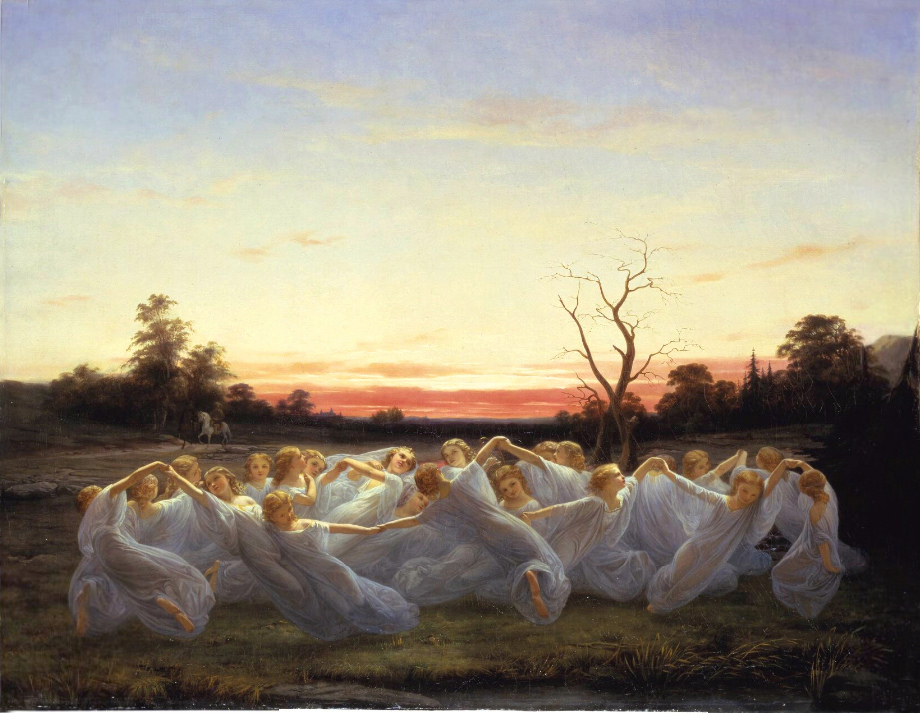
Meadow Elves, by Nils Blommér, depicts a gathering of Light Elves from Álfheimr, one of the nine worlds of Norse mythology. It is said Elves, like all spirits, would gather to dance on the hills during the festivals of Beltane, Midsummer and Samhain.


One of the things that's most impressed me about the history of the Tamrielic Nords is how logical and sensible it actually sounds. While, as I said, the Tamrielic races have no explicit real-world analogues its tough not to spot the influences in Nordic culture. They're Northerners, and it was through The Elder Scrolls I was finally able to come up with a theory about what that might mean. The Nords, the original Nords from Atmora, not the ones who absorbed too much influence from the Cyrodiilic empire and the Dragons they once revered, were mystical, animistic shamans for whom living as harmoniously with the land as was possible was a virtue of paramount importance, and they worshiped the sky as the domain of deified ancestors, and to understand all of this was to understand enlightenment. These are traits the Tamrielic Nords very overtly share with real-life Northerners: It's a cultural model shared by the Indigenous Americans, the Inuit, the Sami, and the real-life pre-Christian, pre-Norse Nordic peoples, and it decisively sets them apart from Westerners: These people are far more similar to each other than they are to those who originated from France, Italy, Spain and Greece. And its to them who I feel I might share a strong kinship with as well.

Fanart by Rafaken of the Throat of the World, the mountain serving as the symbolic and literal centre of the land of Skyrim. Also debatably the tallest peak in Tamriel. It is said the snow on the Throat of the World cannot melt, and dates back to the Dawn Times. The Nords believe humans were created when Kyne, wife of Shor, breathed life upon its peak. Nowadays, the renegade Dragon Paarthurnax, leader of the the Greybeards (a pacifist order of Nordic monks who devote their lives to worship of the Sky), meditates here on the concept of Voice, and how it can be used to touch divinity.

I suppose this would raise the question of how I reconcile my newfound Northerner heritage with my pre-existing magnetic attraction to the ocean, especially the tropical Pacific. In Norse mythology, Skaði, the Jötunn goddess of winter, skiing and the mountains was once married to Njörd, the god of the sea. While together, they split their time evenly between their two realms, with Skaði spending half the year with her husband in the ocean and Njörd spending the other half with his wife in the mountains. But neither was happy with this arrangement, and each would long for home while away from it, so they eventually divorced. But, strangely enough, I find the people the Northerners are most similar to may actually be the Polynesians.

In Donkey Kong Country 3: Dixie Kong's Double Trouble! and its sequel Donkey Kong Land III, Dixie Kong travels to the "Northern Kremisphere", a Northlands-inspired environment south of tropical Donkey Kong Island, eventually discovering the "Lost World", spoken of in myth and legend. The Northern Kremisphere, much like the Kongs' homeland, features tropical jungles intermixed with snow-capped mountains. The Donkey Kong Land series was one of my first real video game loves. Dixie Kong returns in 2014 in the WiiU sequel Donkey Kong Country: Tropical Freeze, by Retro Studios (known for Metroid Prime) and which features Vikings landing on Donkey Kong Island.


Both groups have similar attitudes towards oral history and both revere deified ancestors and elemental spirits. Most critically though, both placed great importance on the interconnectedness of worlds, in particular that of human life with the nature, as they are ultimately one and the same. Both also felt tied to their lands in a very deep and meaningful way-It's just the Poylnesians' “land” was in fact the Pacific Ocean. Indeed, both the Polynesians and the Norse Vikings were exquisite navigators (though the Polynesians were unquestionably superior): In fact, Te Rangi Hīroa's landmark ethnographic history of the Polynesians was titled Vikings of the Sunrise...and was cited by H.R. Ellis Davidson in her comparative analysis of the Celtic, Norse, German and Nordic peoples Myths and Symbols in Pagan Europe: Early Scandinavian and Celtic Religions.

Mauna Kea, as seen from the Ocean. The tallest peak in Hawai'i. Known as Mauna o Wākea, literally "The mountain of Wākea" in the Ancient Hawaiian, and seen as the land of the Gods, home of kind and helpful spirits, the seat of the sky deity Wākea and realm of Poliʻahu, goddess of snow.

I suppose I exist between extremes, or perhaps more accurately where extremes intersect. The Celts divided their year into a light half and a dark half, but it was the in-between times, when both light and dark comingle, that was the most sacred to them. I've never much cared for Fall. Actually, I loathe it. I much prefer Summer and Winter. Like the spirits, I celebrate midsummer and midwinter, but I'm most energized at Samhain and Beltane when summer and winter begin and end and coexist simultaneously. That's when I come alive.

Concept art for Tundraful, the second level of Alice: Madness Returns-American McGee's (of id Software fame) Gothic and surrealist re-interpretation of Alice in Wonderland.

May 4: The Dream-Child takes the Walking Way and learns to Dream.

November 4: The Dreamer Dreams anew, and henceforth Dream becomes Dreamer.

May 4: The Walking Ways lead us to the Mountain, upon which we may touch the sky.

November 4:


SummerXWinter. LightXDark. SeaXSky. These are the names of the Looking-Glass that we find at the turning of the year. The In-Between days remind us that such things are universes apart brought together at the World Tree, the I. Dreamers of Godhood within the Dream of Godhead. We exist at the point between opposite extremes where opposite extremes exist together within themselves. The Mirror-Globe reflects images of ourselves and our own future-past. And so it all begins again.

May 4: Taika, who is Ysmir Storm-Crown, returns as Adaleiz, born Adalhaidis of Atmora.


Snowgirl repainted, by Yoggurt.
 
“Tamriel never belonged to Bethesda. It was the other way around.

As for canon, it's really all interactive fiction, and that should mean something to everyone. That said, I appreciate and understand the stamp of 'official', but I think it will hurt more that it will help in the long run.

TES should be Open Source. It is for me.”

-Michael Kirkbride

Saturday, May 4, 2013

An Account of Queen Alice's Meeting With The Young Adventurer

This is but one of many stories told to children by their village elders involving The Young Adventurer or Queen Alice or both or variations thereupon. As with all such stories, the details differ from version to version, although the fundamental structure is found in all of its forms. The accuracy with which the events chronicled within are described is of course suspect and a matter for debate. Readers are encouraged to formulate their own opinions on the Authenticity and Truthfulness of this particular account.
 
Join me atop the Sacred Rock, for here the All Thing resides.


Then the Young Adventurer ascended the mountain and came upon the Law Stone, which stood within an open meadow. Atop the Stone sat Queen Alice, thrice-exalted usurper and Lady of the Green, her legs folded in the manner of a Lotus, her head adorned with a Crown of deep red flowers. In front of her lay a succession of objects, perfectly arranged in a row. It was known by all that Queen Alice was to be consulted at this juncture, and so the Young Adventurer approached her forthwith.

“My Lady, I have journeyed long and travelled far and I must now seek your counsel. I wish to partake of your wisdom and experience so that I may deepen my knowledge of the Way of the Sword and Shield.”

“You needn't try and explain yourself so,” replied the Queen “For I know your true purpose. You approach me clad in green, or violet, or crimson, or blue or in cold metal or in a mighty helm of brilliant flame. You shall carry on doing so, and you will do so in the hereafter and times long passed. Your intent is surely clear enough; it's your meaning I don't follow.”

“I require training in the martial arts,” the Young Adventurer said “Or, barring that, some formidable tool of honour and power that will aid me on my quest. Is that not the purpose of this assortment of items between us?”

“What you see in front of you is what you wish to see” Queen Alice said “Or perhaps,” she hastily added “What you expect to see. I appear to you in this manner because I am expected to and am thus invoked, though I appear in this form because it rather suits me. We have met this way before and we shall continue to meet this way time and time again until the world grows dark and the land grows cold.”

Confused, the Young Adventurer countered “I see what I see in front of me because it is there and it was there before I climbed this summit. How can it be otherwise?”

Alice responded “What you see are half-truths; between us stands an impenetrable wall of nothingness. You bear witness to the simulacra of meaning and virtue.”

“Is a Thing Not-A-Thing? What I desire and what I am presented with have no correlation, as you are right now effectively demonstrating.”

“A Thing ca'n't be without its symbol.” Alice gestured to her collection of objects “I could give you this this canoe (which is the world) this book (which is the link in the chain), this ball (which is the aspect of thunder and lightning), this skateboard (which is the door and the eye), this cobra (which is the voice of the dragon) or this wheel (which is the tower) and each would be useless to you stripped of their subject. Furthermore I daresay they mayn’t even exist if you wished it.”

The Young Adventurer was now thoroughly confused, and asked of Queen Alice “What is the purpose of all these riddles and symbols? This is getting me nowhere! I've come all this way and I should like to have some answers to all of this.”

“They get you nowhere because you choose not to follow them, of course,” said Alice. “The secrets of which you speak and seek are spelled out before you; answers written in words carved out of summer's clear sky. Pick a path and follow it, for it shall lead you towards divinity.”

The Young Adventurer was growing angry and proceeded to criticize Queen Alice “Will you not give me what I seek, or are you simply incapable of giving it? Is a Queen not a Queen if I wish her not to be? For in you I see the simulacrum of a regent. Does a Queen not sit on a throne and preside over her land and people? Pray, tell me: Where do you rule and who are your subjects?” The Young Adventurer said this, for it seemed Queen Alice possessed none of these Things, then added one final question: “What Are You?”

“Is the answer to your question not already clear? Do the words not appear before you, though you are unwilling to read them?” Alice replied “I am the Queen without a throne, for my throne is the field of scented rushes. I am the Queen without a queendom for my queendom is the Earth, the Ocean, the Sky and the space beyond and between. I am ruler of everything and nobody. I am the third of two Queens of Dreaming and have no predecessor or heir for my apotheosis was my will. I am Woman-Become-Goddess and Goddess-Become-Woman. I am the form to which you must aspire.”

To this the Young Adventurer had no response, so Queen Alice thus continued “Do you not see some reflection of yourself in me? Is that not this reason you have come yearning for my company and guidance at this moment in time?” Alice paused for a moment, than continued “You seek wisdom and meaning. These are not Things I can give you, but things which you must discover yourself and absorb into your aspect. But you also seek knowledge of topics with which I have a particular experience. Such knowledge is the beginning of a path, so this I will tell you.”

The Young Adventurer raised no objection to this, for the quest must continue, thus there was no objection that could be raised. “Talk with me then about The Path.”

“There is not one Path, but many paths. The road and the destination can remain the same, but should the trees change colour or the cobblestones be re-layed, the path will likewise change.”

“Surely The Path remains the same? The Road still stretches across the same piece of land and it still ends up at the same place.”

“A road is only a Thing if you perceive it to be such. A road becomes a path when a Master perceives it to be one. Or perhaps rather, the path is the way to become a Master, but only a Master can recognise it as such. Either or both. The path is the Endeavour.”

Queen Alice knew this puzzled the Young Adventurer, for she had seen a vision of it doing so before the words left her lips, so she shared a story. This was that story.

“It is a truth that in the days when I walked alongside my foster-father I was a warrior, much as you are presently. A Warrior Queen assumes her mantle through combat, and I am coronated through the slaying of the High King: I slew him once in the Hills of Erin upon the raven’s wings, once in the House of False Love, once in the Mead Halls of the Gods and again atop the City of Fire. I likewise felled him amongst the Missing-Birds of Aetherius and in Darkness and in Sadness and then in the Dreaming, which is all places and all moments. The clashing of our swords echoes back to the dawn of time and forward to the End of All Things.”

Alice continued “My infinite victories win me only my self, which is nothing, yet everything. This is true inasmuch as it happened, I exist, and therefore this must have happened. But it is also a truth that in those days I wore the Storm Crown and thus did righteously slay the High King, for he knew not Love, and had I not the world would become Poison and I should cease to be.”

“So one becomes a Master by finding a path, following that path, and slaying he who resides at the end of the path.” The Young Adventurer offered.

“It is a truth that heaven may be reached by violence,” Alice responded “But I slay kings with Love myself. They are not such disparate forces, you know. The House falls for it promises Love where there is none. A real Master knows the value and power in this.”

“What more must a Master know?”

“That a Master is not a Master until The Name is both spoken and forgotten. Only then can Masters recognise themselves and attain liberation, wisdom and power, which are the same. I am Alice and I am Not, but I Am. This is the true purpose of the path, for the path is the Endeavour. One needn't worry so much about the end of a road, it's the walking that's important. After all, one ca'n't go around slaying kings all the time, now can one? Bearing the Sun Crown I travel where I may; my processional train the daylight of summer itself.”

“But the warmth of a summer's day can turn just as quickly to the fury of thunderstorm...” the Young Adventurer almost hesitated to point out.

Queen Alice smiled warmly and said “I was born in both and exist in both. Always and forever.” for she was not at all ashamed to admit this.

The Young Adventurer thought about that for a time, and then asked Queen Alice “Pray, My Lady. Please tell me about The Dreaming.”

“The Dreaming is part of everyone and everything, and everyone and everything is also part of The Dreaming. It is shared between all, yet it is also the domain that no two people may ever truly share. It is above and beyond and deep within. It existed long before this moment and shall carry on forever after it.”

“But which dreamt it, then? Whose dream?”

“The Dream is the Dreamer, and the Dreamer the Dream.”

“But,” the Young Adventurer cried out “If I am nothing but a Dream than nothing I do shall ever amount to anything and I have wasted all these many hours!”

“Hush now,” Alice spoke softly and gently “There's no need for that sort of talk. For the true mark of a Master is learning the secret and one true purpose of The Dreaming: A Dream may Dream as Dreamers do. The Dream remains and is reborn again. Eternally.”

While this wasn't entirely comforting, the Young Adventurer said nothing, but continued to listen to Queen Alice with rapt attention, so she went on. “We all leave our mark on The Dreaming, don't you see? It is always around us and we always feel its presence, though we may not be able to reach back to it. A Master may do so, for a Master walks both in the land of the Dreamtime and in that of the Waking Dream. That is the true purpose of the path.”

After some thought, the Young Adventurer finally spoke, saying this: “I believe what you say is a truth, though I also believe I mayn't see it quite the same way. But I shall heed these things you have told me, for I must continue my quest.” Queen Alice knew this would be the answer, for she had foreseen it far into the future.

“Come now,” she said, her elfin sun-smile once again crossing her lips “Sit with me for a time upon the meadow of flowers. Cast your gaze to the valleys in bloom, the river which flows ever on to the sea and the mountains of snow from whose summits you can touch the sky. Meditate on these Words I have given you, for hidden within them is the secret of the Endeavour.”

You shall learn to Dream with the dawning of the sun on a brighter day. Your path lies before you.

Wednesday, July 4, 2012

“Dear lost companions of my tuneful art”: Gamer Culture and A Life on Video (Part II-At Home and Abroad)

WYSIWYG
One of the ways Nintendo was able to rebuild the viability of home video games after Atari imploded and took the whole industry with it in 1983 was to reconceptualize video games as children's toys. It may seem strange to look back from our vantage point and observe how bizarre and radical a shift this was, but it was a very deliberate and tangible change in direction with repercussions. Nintendo had been expressly warned that launching a new game console in the wake of Atari guaranteed them failure as Atari's collapse had tainted the entire industry. Therefore, Nintendo consciously marketed the NES in the US as a hot new toy for kids in an attempt to avoid comparisons with the failed Atari 2600 and other personal computers that were starting to dominate the consumer electronics market. Afterward, and once it was a reasonable assumption that the majority of youngsters had access to an NES, it became very easy to take this fact and build a huge merchandising empire out of it. There was Nintendo breakfast cereal, Nintendo bedsheets, Nintendo clothes, Nintendo action figures, Nintendo stuffed animals, Nintendo sports equipment (*yes*) and even Nintendo Saturday Morning Cartoon shows (they were all crap, in case you're wondering, but this really isn't the place to talk about Saturday Morning Cartoon shows in any detail). But that's far from all that was going on with NOA and the NES: the clever idea they had was this. Once all the parents bought their kids Nintendo consoles and games for the Holidays, they'd be able to subtly start showing off the machine's true potential and capabilities. It worked, and worked amazingly well.

The conflation of games with toys that really started with the NES may be where some of the stigma gamers claim to experience originated from, as it could be said they never “outgrew” their “toys”, but it's telling no similar strategy was used in Japan, where the thing was simply dubbed the Family Computer and even had a floppy disk drive and a planned rudimentary Internet-like system. It's also crucial to note that Shigeru Miyamoto's early arcade games, Donkey Kong and Mario Bros. were expressly not designed to be solely kids' fare, meant to to be played as they were in bars. But of course we know better: NOA's little scheme to sneak the NES into households under the radar was absolute genius, and it was a common occurrence in many homes for parents to put their kids to bed after an evening of watching them play Mario and then, after the kids were asleep, to creep back downstairs and spend the rest of the night playing Nintendo themselves. Many grandparents were enthralled by the new games too and would discuss them just as earnestly and fervently with each other as their grandchildren did.

This was of course Nintendo's goal from the start: To make games anyone could enjoy, appreciate and share. This is an intellectual tradition of theirs that dates back to Donkey Kong, the Game and Watch series and their skeet shooting ranges. I surely need not remind my readers their first console was called the Family Computer. This is why I'm so continually baffled by people who bemoan the Wii and it's abandoning of the “hardcore” to court the “casual, social crowd”. As if Nintendo had ever catered exclusively to the “hardcore gamers” (a term of self-definition I personally find incredibly intellectually and historiographically lacking). Nintendo's games have always been for anyone who possessed a child's unconditional love of life, no matter what the biological or calendar age. No-one is entitled to a monopoly on them.

In any case, given the Nintendo saturation that was prevalent in the late '80s and early '90s, and even after Nintendo of America made a concerted effort to make video games synonymous with kids' stuff, which the medium absolutely had never been before 1985 or so, I can say from my experience at least that neither myself nor anyone I knew was ever persecuted or bullied for liking video games. It was just something kids did: You talked about Nintendo on the playground, went home, ran around outside for a bit, played some video games and watched TV. If it was the summer, you'd split your time between traipsing around forests building forts and playing kick-the-can and eating lunch with the Nintendo. To be perfectly honest and fair I was homeschooled for a lot of my childhood so the interaction with friends and the use of the playground as a social centre was a bit limited for me personally a lot of the time, though I did witness it and have comparable experiences with the friends I did make and members of my own family. In a previous post I've already recounted my memory of playing Super Mario Bros. at my cousins' house: Playing video games together with them was a regular occurrence, either at our place or theirs and was usually done after coming in from having adventures outdoors for the day and before dinner (and after at times as well) and those evenings spent playing local multiplayer on the NES or passing a Game Boy back-and-forth with my cousins are some of my most treasured.

As I got older and travelled elsewhere, home video game consoles continued to be a source of social bonding for me. For a time in my teenage years I attended a school where Olympic-bound athletes would take their lessons during their training period. The campus during that time was a weird confluence of extremely determined professional athletes, serious academic-minded scholars, artists and conservationists. It was an utterly unique and valuable experience and I even got to train with the local snowboard team for a bit while I was there. Video games were a big part of my social life there too, as me and the rest of the trainees would often hang out in the lounge after school taking turns on the communal NES and various SEGA consoles (there really were quite a lot of those, weren't there? And all out at the same time too). One of the at once coolest and strangest things I remember happening was hanging around the lounge alone after hours one evening playing Super Mario Bros. and having my science teacher, a charming young lady fresh out of college who split her time between teaching at the school and working as a tour guide and ecologist on the summit of the tallest mountain in the state, walk in and, seeing what I was playing, excitedly sit down next to me and jump into the game with me. She even taught me some of her signature tricks to navigate the underground levels-it was awesome.

Every new place I go games have traditionally been a kind of glue that held my various social connections together. From joining my whole dorm in an impromptu Halo: Combat Evolved tournament on the lounge XBOX, throwing LAN parties with my suite-mates over a local network we Gerry-rigged together for us and us alone to late-night Super Smash Bros. jam sessions with the guys from the common house, video games have continued to frequently go along with some of the best memories I've shared with my friends and family. And, just as always, everybody played: Girls, boys, athletes, alpine tundra ecologists, creative writing students, artists, frat guys, humanities scholars and astronomers. There was never anything strange or unusual about that: Video games were a universally shared cultural experience, just like any other kind of media, hobby or activity. I'd never thought of them otherwise.

Because of this, I've been presented with quite a few large and confounding philosophical problems these last few years. Things like “When did video games ever fall out of the 'mainstream'?”, “Where did the self professed gamers come from, why are they apparently so horribly persecuted?” “Why does playing video games constitute a subcultural lifestyle any more than watching movies, reading books or listening to music does?” and perhaps most annoyingly “Where are all these big mean jocks who are supposed to bully me for playing video games? I mean, I went to a jock school forchrissakes: If anything qualifies for that label it's a school for Olympic athletes in training. The only jocks I knew were the ones playing Nintendo with me in the lounge. Does that make me a big mean jock too? Do gamers just watch too many John Hughes movies?”.

In spite of the attitude my above glibness might imply, I'm not intending any of this to belittle anyone's personal experiences with video games as a medium or in anyway claim their positionality is imagined or fallacious or that mine is more valid. What I am saying is that my positionality is radically different from theirs, to the point of complete incongruity, and I don't understand why. There certainly does seem to have been a shift in the way video games were generally perceived and a clear-cut turn to a presumption that the medium has always been underground and fighting for legitimacy, I'm just not sure when and why that happened or where it came from. I certainly remember some half-baked moral panics in the mid-1990s to early 2000s over games like Mortal Kombat, Grand Theft Auto III and some of id Software's early games and that some especially obnoxious politicians were complaining games were corrupting the youth, but I honestly remember that never being something anybody really took too seriously (the Columbine school shooting aside, of course, but even that seemed to resolve itself rather quickly) and the sort of thing that happened to all young media, like rock music and witchcraft. There is of course the omnipresent existential nightmare of how video games handle narrative and how they compare to other forms of media in terms of artistic expression and value (goodness knows I've written enough on that already and I'm far from through yet), but that's a problem of self-reflection the industry brought on itself, not had imposed on it from the outside.

I'm also not saying bullying and bigotry isn't a problem for far too many people: In fact, the older I get the more convinced I am it's the defining aspect of Western society. I was picked on as a kid too, though not nearly to the same extent as others and nowhere near as much as I would have had I not been an extremely private person, and only so far as the fact my elementary school was full of egomaniacal bastards who were horrible to everybody. In other words, of all the things I was made fun of for growing up, playing video games was not one of them. And while I never experienced any video game-driven harassment as a kid, or at any other age for that matter, this does segue nicely into my final point which is, if video games had never been a harsh, exclusive, unwelcoming environment in the past, they bloody well are NOW and most of the vitriol is coming from within the so-called “gamer” community and is being perpetuated by the industry itself.

While I of course am going to avoid generalizations and stereotypes and know full well not all self-professed gamers are angry, bigoted people there's no way to put a fine point on this: The games industry as it stands today is a damn scary place as far as I'm concerned and honestly makes me ashamed to be involved with it at times. The treatment of women is particularly unforgivable: Just this past year we've had competitors at a Capcom-sponsored Street Fighter tournament sexually harass a female player to the point she was forced to drop out, a sizable army of cyberbullies send incalculable amounts of appalling hate speech and threats of violence to a female producer attempting a startup campaign for a Web TV show about Male Gaze in video games and not one but TWO high profile games journalists getting fired for verbally abusing female personalities over the Internet in clearly sexualized ways. I'd go into these cases more and scores others to boot, but I'll instead link to this article which summarises them all nicely.

It's not just from the gamers: Our industry thrives on sexualized violence, and why not if that's what its consumers want? I briefly mentioned the male domination subtext in the blockbuster hit Batman: Arkham City in the past and the questionable gender politics inherent in franchises like Call of Duty and Gears of War should hopefully require no elucidation. This year we even got a lovely trailer for the new Hitman game, Absolution, which took great pains to show protagonist Agent 42 brutally slaughtering a group of supermodel female assassins dressed in fetish nun gear. However, for my money there's no better example than the games proudly showed off to legions of jubilant games journalists at E3 2012. The Far Cry 3 demo began with a minigame where the player gets to grope a submissive female NPC's blocky breasts and proceeds into a horrific bloodbath of explicit and brutal violence. Assassin’s Creed 3, the latest entry in a franchise already about creative ways to murder people, clearly revels in the new elegant ways to dispatch the many representations of living things contained within. New entries in the Splinter Cell and Tomb Raider series were no different, the latter even being an exciting reboot where pioneering video game leading lady Lara Croft gets a new violent and depraved backstory and gets threatened with rape at numerous points in the game to make her feel more “vulnerable” and “realistic” so players would want to “protect” her. Hell, even Watch Dogs, arguably the most interesting reveal at the show, has one or two fairly disturbing moments.

I'm not one to defend censorship or claim violence has no place in fiction, but there's a difference in the way the violence was treated here. If you must use overly violent content in your work, it ought to have a purpose, usually to show off how serious and disturbing the setting has become. None of these games do any of that, and it seems more and more like gamers don't care. This violence is sexualized and celebrated in a way that alarms me (especially given this industry's obvious problems with women in general), and both the producers and critics seem on the whole fine with this. This editorial from GamesRadar adequately relates the sickening feeling and impending sense of dread I got sitting through this year's E3 and the problem is so pervasive and evident that both Warren Spector and Shigeru Miyamoto have publicly come out to condemn it. What this year has ultimately shown me is how out-of-touch the games industry has drifted from reality and I from it. Simply put, this medium is unrecognizable to me and both the latest crop of games and the sentiment I'm getting from the “gamer culture” these past few years is most assuredly not why I fell in love with video games. Should the industry continue down this path, I'll eventually, and sooner rather than later, run out of positive things to say about it or really anything to say about it at all.

It seems to me, to quickly and unfairly psychoanalyse a ludicrously large swatch of people, that these most vocal aspects of “gamer culture” seem terrified their Old Boys Club might actually be split open to allow other people entry, even (gasp) women. This is positively ludicrous. As I've spent the last obscenely long tract arguing, video games are, and always have been, for everybody. They are, at least from my experience, a unique and intimate way to connect people separated by distance, worldview or even (and especially) in the same room. If “gamers” continue to complain about being unfairly marginalized and this is the best they can come up with to argue their case, well then frankly they ought to be ignored. Any creative outlet or culture this insular and hateful has no right to any kind of voice at a public forum or really even to exist. I still may not know who these gamers are and where they came from, but to be perfectly honest if this is how they represent themselves I don't want to know, nor do I want anything to do with them and I'll be damned if I let them selfishly hoard our shared cultural traditions and experiences. What I'd rather learn is what happened tho the kind of communal spirit and attitude towards video games I remember from my childhood and I know for a fact existed thanks to historical record. More to the point, I'd like to know if there's any way to ever get it back or if it too is forever doomed to be an artefact of history alongside my NES, the Pong cabinet at my local pizza parlour or the video arcades that used to be on every kid's street corners.

Tuesday, January 17, 2012

“But What Does It All Mean?”: Lacanian Reading and Video Games (Part II)


Borromean RingsOK, let's back up and take a look at what I just did. In brief, I wrote a basic little analytical essay about Super Mario Bros., drawing conclusions about it based upon what I could glean about Shigeru Miyamoto's inspirations and worldviews and the actual text of the game. I started off talking about how Dave Sheff recounts elements of Miyamoto's biography, and then I took that information and dovetailed it into an essay in which I essentially argue that Super Mario Bros. is a piece of radical deconstructivist commentary on the video game medium and player's expectations circa 1985 and, furthermore, serves as an outlet for Shigeru Miyamoto to share experiences and emotions with an audience. What I've done is constructed an argument consciously and explicitly out of the first two layers of a Lacanian reading: The actual text and authorial intent. There is, however, a bit more work to be done because there is, of course, a third level to this analysis.

The third level is perhaps the most difficult to come to terms with as it is fluid and defies easy explanatory devices: It is the way in which the text resonated with its audience. Put another way, it's what the text means to the individual reader. This is the part that probably isn't taught in most English classes (though talented ones can implicitly foster it) as it cannot be quantitatively measured or tested: It directly calls upon the reader's positionality, that is the unique set of preconceptions, associations and experiences that any given reader, and only that given reader, brings to the discussion table. What does the text mean to you? What did you, personally, take away from it? This to me is the most revelatory part of the theory Felman, via Lacan, outlines and when joined to the other sides creates a powerful dynamic reaction that yields practically limitless explanatory power. Because then, and only then, can we finally tease out what any given text actually means: By looking at it in the context of these three dynamically interacting spheres. Meaning isn't one thing that a text inherently has: It's not something that the author “hid” under layers of irritating, obfuscating metaphors and symbols and is cruelly making you “dig up” and “unearth”. No, meaning is an intangible and ever-changing thing that is generated by the act of reading itself through the dynamic interaction of these three core principles.

I've already touched upon this third sphere to an extent already: Much of the leverage I have to claim Super Mario Bros. is a work of radical deconstructive game design in the previous essay is because that's what it plays like to me. This isn't something Miyamoto has expressly confirmed, but it's present and noticeable to me when I put it in the cultural context of the time. It's also something other critics have picked up on, so I'm not the only one to notice it. To continue my argument, I should logically now explain to you what the game says to me as a playerXreader. I could now rattle off a few comfortable paragraphs about how I interpret Miyamoto's vision within the context of the game, but there's an additional wrinkle here: This is Super Mario Bros. In many ways, this is the game that single-handedly made me fall in love with the medium and showed off its full potential for creative and artistic expression. It is impossible for me to disentangle it from my own childhood memories of staring with rapture at a hazy 1980s television set and having my life changed forever. So, for me to do this properly, I have to do a bit of reminiscing and autobiography.

...

This story begins, as many of my formative ones do, with my cousins. They lived about six hours away so we didn't see them very often, but whenever we did it was an occasion. This was my first time visiting them at their newer house (I hesitate to say "new" because they had lived there for quite some time and we'd just never visited). Not long after arriving and settling in, my oldest cousin (who had first exposed me to video games in the first place via the Game Boy he always had on him when he travelled and brought whenever he visited us, but that's another story) urged me to come upstairs to his game room so he could show me something cool. It was his Nintendo Entertainment System, the original one with the wonky side-loading cartridge system that broke down when you looked at it funny. The first game he wanted to show me was Super Mario Bros./Duck Hunt, a special pack combining the game we've been spending a great deal of time talking about with the surprisingly excellent and accurate (for the time) skeet shooting simulator Duck Hunt.

That single event is permanently etched into my mind it was so important to me. To this day I can remember the exact look and layout of that house to the tiniest detail: The sprawling suburb in which it was situated, the diminutive front yard, the big open first floor, the deck leading out to the pool and the backyard, the spiral staircase, the long corridor upstairs and the bright games room (made even brighter by the vibrant summer sunshine pouring in through the large window to the right) with the fuzzy 1980s television sitting on top of the entertainment centre with the NES beneath it and the stack of games in the long file beneath the bed.

Super Mario Bros. was by no means the first video game I'd ever played, but it had an effect on me unlike almost any I'd played up to that point. Super Mario Bros. was literally unlike anything I'd ever played before and for very subtle and specific reasons. I'd played sidescrollers and platformers before and I certainly knew who Mario was (I'd played a few of his earliest games beforehand) so the actual gameplay was nothing particularly revelatory. What Super Mario Bros. did that I'd never seen a video game do before was exude an atmosphere, a sense of place and of emotion from every single detail. The first thing that struck me was how vibrant, warm and inviting the game's colour palette was, full of striking blues, greens, reds, pinks and oranges. There was literally no other game that looked like it: Every other game I was familiar with was in black and white, grey-scale or that classic arcade dark psychedelic vector neon that's a vibe unto itself. Super Mario Bros., helped in no small part by the lush summer sun pouring in through the open window and reflecting off the trees and grass outside, felt young, fresh and full of life.

Whole articles could, and have, been written about Super Mario Bros.'s theme song alone. It's a positively enchanting and infectious Calypso/Latin fusion piece that was surprisingly musically complex for its time. Like the colour palette, it was like nothing else at the time, coming into a world of 8-bit techno beats, brief little jingles and games that were silent save for scratchy laser blasts, explosions and bleeps. The Super Mario Bros. theme, like all good songs, sets a mood and uses music to paint a picture in the mind. Combined with the games already bright visual style, the song melds with the other aspects of the game to build a mood with magnificent nuance and elegance. The Mushroom Kingdom is not overtly tropical in climate, but Super Mario Bros. is simply made of dazzling, summery emotions and a sense of wonder and youthful joy. Despite its nigh-infinite number of remixes, covers, adaptations and samples, not to mention copious usage in other games, the best possible way to listen to the song outside Super Mario Bros. proper is to find a steel pan trio playing it: It simply feels right.

But perhaps the most remarkable thing about the world of Super Mario Bros. that struck me is that it *changed*: After the initial level sets you up for a pseudo-tropical romp, Level 2 dumps you in what amounts to a sewer. Level 3 returns you to the surface, but makes you clamber over soaring cliffs. The fourth level of every world (and the fact that Super Mario Bros. has eight “worlds” made up of four “Levels” each made it seem indescribably large and sprawling for the time) is a dank castle with fire sticks, lava pits and giant fire-breathing monsters. Some levels even take place at night, which was something I'd also never seen done before. As the game progress into its later levels, the overworld itself changes seeming to get paler and harsher the further you get (trees turn from green to white, for example) as if Mario and Luigi are steadfastly moving north. This culminated in one level set in what seemed to be a frozen tundra at night where everything has a sleek, white sheen. It even snowed onscreen! The fact that this gorgeous snow effect was, as my cousin later informed me, a result of his hand-me-down television going on the fritz instead of some genius design decision by Miyamoto did little to take away from the magic of playing through that level the first time. Temperamental television or no, the fact remains that all of this came together to make Super Mario Bros. the first game I played that felt like it took place in a cohesive, living, breathing world, which made exploring its various secrets all the more substantial and enjoyable.

Super Mario Bros. for me than is an absolute triumph of game design and playing it was one of the most important moments of my life. Because of it, I really started to see what video games had to offer as a medium. With Super Mario Bros., Miyamoto gives us his first, and arguably still best, master stroke: Using brilliantly nuanced game design to put the joy of exploring, of living in wonder and just plain living front and centre and allowing someone like me to experience it in the bright, naturally lit games room at my cousin's house the same way he himself experienced it so many years ago as a child in the city streets or the forests behind his Kyoto home.

Because that's what he's done, of course. He's created a work that is a reflection of his personal feelings and viewpoints that has successfully recreated for countless people around the world the very sensations and experiences that helped make him into the person he became. In other words, Miyamoto, through Super Mario Bros., has actually literalized the Lacanian concept of reading as a fundamental tenant of his game design philosophy: The authorial intent is obvious, but the fact that the text of the game allows players to actually discover and feel such things on their own through the agency the medium provides indicates Miyamoto is aware of positionality and how to exploit it to share experiences with his audience. This is the true potential of video games as a medium of artistic expression in my view: It's one thing to tell a story with heroic characters you relate to about themes you care about, but to actually be able to share an experience, share an emotion, and have the reader be able to not just witness it but experience it themselves, that's something else altogether, and something almost unique to video games in my opinion.

...

What I've done here is use my experiences with Super Mario Bros. to make another argument-In this case that video games are inherently, literally Lacanian (at least ones with skilled designers. There are exceptions, but I'm not ready to discuss those yet) The reason I spent so much time talking about my personal relationship with the game is not just for me to indulge in misty-eyed nostalgia: My history with the game, and crucially my history of experiences dating from before the point at which I picked it up for the first time, is essential to understanding the positionality I inhabited as I played it, how my positionality shifted after I played it and crucially, how that affected the way I read it.

Positionality is key to utilising the third sphere of Lacanian reading as Felman describes it, because it's only through getting ahold of one's associations, relations and preconceptions that we are able to understand how any given reader will respond to a text. In my case, Super Mario Bros. dramatically shifted my conception of what video games were capable of, and is probably why I'm sitting here writing this now. So, if you're looking for someone to blame for my incoherent academic gobbledygook blame Shigeru Miyamoto. Well, and Jacques Lacan. And Shoshana Felman. And my philosophy teacher who introduced me to both. And my Anthropology professor who set me on the path to joining this field. And...

Which brings us to the real delicious irony of this whole thing: Reading is not just one act, but the chaotic interaction of many and varied acts, individuals and texts. I just spent a series of essays writing about Shigeru Miyamoto (whom I understand primarily through what Dave Sheff wrote about him in a book I read) through tools I learned from Shoshana Felman who learned them from Jacques Lacan, who was resolute in his claim that he was doing nothing more than reading Sigmund Freud, which I read because my professor read them and thought I should as well. Not to mention the fact large portions of this series have been dedicated to me reading and analysing myself, and you reading me as I do that. Somewhere in this grand, beautiful symphonic cacophony and language and discourse is meaning. But meaning is, as I've claimed, not one thing, but a mutable, ethereal series of concepts dynamically generated by the interaction of three forces and countless subjects whenever anyone reads anything.

This then is finally how we can judge whether any given reading is “valid”: The addition of the third sphere would, at cursory glance, seem to render all analyses into exercises in futile relativism, but rather what it does instead is give us a more nuanced way to practise it. All we need to do to determine whether a reading is valid or not is to weigh how it utilises the three spheres against itself. For example, I can claim Super Mario Bros. is a work of radical deconstructive game design that literalizes the concept of Lacanian meaning to recreate for players the experiences of exploration and discovery treasured by Shigeru Miyamoto. I can do this because I've (hopefully) provided enough evidence from both what is on record about Miyamoto's intent, my personal experiences with reading it and the actual text itself to back up my claim. I couldn't, however, claim Super Mario Bros. is about a magical flying hamster who soars through Candy Land turning clouds into doughnuts to fight Communism because there is absolutely nothing in the game or what Miyamoto said about it that could remotely be used to support such an assertion, no matter what my personal experiences might be. One is a valid interpretation, the other isn't. One constitutes a legitimate reading of the text, the other is me reading the text wrong.

On the other hand, this is also why no-one can claim I am "reading too much" into a simple video game from 1985 or "picking up on things that aren't there", because the very act of ever reading anything is inherently bound by these forces and interactions. These are the conclusions to which I have arrived at via my history of reading things, and not just video games, as texts from a particular positionality. This then is the core of analysis for me, and the tool set by which I'm going to approach anything else I do on this blog.

Monday, January 9, 2012

“But What Does It All Mean?”: Lacanian Reading and Video Games (Part I)

It's-a-me...
At the risk of dredging up the tired “Are Games Art?” debate, I think it's safe to say that anyone taking the time to read this weblog has probably felt some kind of emotional connection with a game at some point during their lives. Whether they cause us to see things a different way, force us to ask provocative questions, immerse us in an engaging fantasy world or give us vivid characters and stories to relate to, video games, like all forms of creative expression, have the power to resonate with us on a personal level and leave a lasting impression. Taking the time to unpack this truism, however, is an altogether different project and one that is uniquely rewarding. If it is safe to claim that games *can* affect us and that *why* they affect us differs from person to person, what about asking a third question? That is, *how* do they affect us as human players? Well, perhaps I ought to call us “readers”, because for this piece I'm going to try and subtly move us away from the language of pure game journalism and into the language of philosophy, media studies and, to be blunt, artistry.

The reason I make that fine redefinition of terms is that I believe video games can be read and understood as what we call “texts” in the world of theoretical humanities and social sciences. The word “text” carries an implied connection to books (which is typically what we talk about in philosophy), but really it can be applied to any creative work that has textual, subtextual and meta-textual elements to it, like a movie, a piece of music or, yes, a video game. I think the world of philosophy, media studies, qualitative social science and radical psychoanalysis offers a wide array of tools that we can use to look at games and read them better, and part of the reason I started this site was so I could highlight them and hopefully contribute something to a new level of discourse for our medium. That said, one of the simplest, most profound and most important tools we now have available to us is the concept of textual meaning, and, more to the point, where it comes from and how we read it.

There have been many theories and many debates about how we communicate, discuss and read one another, but the one I think is most appropriate to us is the one embodied by the work of one Jacques Lacan. Lacan was a controversial mid-20th Century French psychiatrist and psychoanalyst who nevertheless wound up making a sizeable number of important contributions to a bunch of different fields apart from clinical psychiatry, like philosophy, sociology, feminist theory, literary and film studies. Although, truth be known, we're actually going to be drawing more from Yale University professor Shoshana Felman’s contemporary reading of Lacan put forth in her truly excellent book Jacques Lacan and the Adventure of Insight. In it, Felman argues that Lacan’s work can be read as a kind of metaphor or subject, through which we can re-evaluate what it means to be a reader and what it means to be contemporary. In other words, Felman thinks that psychoanalysis, particularly the kind done by Lacan, has made possible a unique new way of reading that allows us to get a closer look at the actual act of reading itself and the significance that has for discourse.

I'm going to extrapolate Felman’s analysis further, using her conception of reading and the reader gleaned from Lacan as a starting point. For you see in this piece I am going to make the claim that not only can video games be read in exactly the same manner as any other kind of text, but that talented game designers can actually literalize this way of reading works as a key part of the final product. This is actually an underlying principle of the way I approach games and gaming, and I'll be returning to this thesis many times in subsequent articles for this site because I think it can be applied to any number of different titles and situations. For the meantime, however, I am going to concentrate on one game I feel is a perfect microcosm of my theory but of which, in a deliciously paradoxical manner, this might not be apparent at first: Shigeru Miyamoto’s groundbreaking 1985 classic, Super Mario Bros.

And yes, for those of you keeping score at home, I am reading Felman’s reading of Lacan (who more often than not was reading Freud in his work), and then appropriating those concepts so that I can read Super Mario Bros. I'm also going to be basing the conclusions of my case study somewhat on what Dave Sheff wrote about what Miyamoto said to him in the 1998 book Game Over: Press Start to Continue, but I'll touch more on that later. And, by the way, you're reading me as I'm doing all this, so that's another layer in of itself. Isn't deconstructive philosophy fun? Of course it is, so lets get started. But first, let's learn a little more about Lacanian thought and how we can even know what anything ever means.

Felman has quite a lot of different applications for Lacan’s work in contemporary philosophy and literature studies, but the one most relevant to us is the idea of how meaning is generated. Essentially, what a text “means”, what it's “about” and how it acquires any level of significance other than words on paper (or in our case binary bits in an NES cartridge). If you think back to your High School English days (and I knew as soon as I wrote those words some of you weren't going to want to, but bear with me-it wont be long) you'll probably remember your teachers once told you how great works of literature have a “deeper meaning” inherent in the text and how to look for symbolism and metaphors within it that explicitly related to those overarching themes and concepts. Some walk away from those classes thinking authors spend months and months toiling away at works to load it up with as many obscure symbols and hidden concepts designed to create for the reader a nasty web of ideas forcing them to analyse each and every last little thing. While I'm not denying some authors might do this (I can think of a few right now) this is, at heart an overly-simplified, reductive and narrow-minded way of approaching texts. In fact, I feel perhaps the most important thing to take away from this discussion is that textual meaning does not derive solely from the author (the author is certainly important, and that's a point I'm going to return to, but there's more to it than that). Here's what I think Felman, and by extension Lacan, is saying:

When we read a text, there are actually three very specific things happening in tandem that work together in order to generate meaning. Therefore, if we're ever going to figure out what our works mean, we have to pick apart each one of them and keep them in mind, because this is not only where we're going to figure out what the meaning is according to this specific reading (and yes, it will change depending on the reader), but it's also going to help us decide what constitutes a valid reading (more on that a little later). Let's look at these three concepts then: Firstly and probably most importantly, is what does the text actually, literally say? In a book, this is the first and easiest step: Pick it up and read those words. What are the actual words printed on the page (or represented by pixels on your iPad)? It boils down to a very simple binary (though I usually dislike them immensely): Did you or did you not actually read this book?

In my Super Mario Bros. example this is a little trickier because the game has next to no dialogue, but we can discern a lot from things like the onscreen prompts and the sumptuous instruction manual Nintendo kindly provided, which, for the purposes of this exercise I'm going to count as part of the game, mostly because without it Super Mario Bros. essentially has no story seeing as how the technology wasn't capable of fully conveying one yet. This isn't even taking into account the somewhat obvious fact that if you picked up the game when it first came out without reading the manual you probably would have absolutely no idea what you were looking at. In more recent games there are other ways of reading this level like in-game cutscenes, acted dialogue or pantomime sequences.

Returning to my case study, however, what we can discern about Super Mario Bros. on a superficial level is that it's a video game where you move a sprite left to right, jumping over obstacles and looking for passageways. The manual elaborates on this further, telling us that we “are” one Mario (a very important and loaded phrase that demands deeper later examination), a humble plumber who vows to help repel a band of wizard turtles who have invaded the Mushroom Kingdom and kidnapped Princess Toadstool, who is the only one versed in magic enough to defeat the invaders. The “Bros.” comes from the fact that Mario’s brother Luigi joins him on the adventure and can be controlled by a second player. Right away we can ascertain a basic yet fairly functional idea of what this game is, however we're far from done.

The second key needed in creating a claim to meaning is the obvious: Authorial intent. That is, what did the authors of the work intend when they sat down to write it? Now, this is a very complex issue and I actually fear the words I have laid out are not fully capable of conveying the thorniness of it. In brief, the whole notion of intentionality is a contentious one and one certainly worthy of full examination at a later date (I can already think of at least two philosophers who would like a word or two with me after saying this). For the moment though, let's simplify things and say that yes, the author had a specific intention to create a work and a specific idea of what the work is supposed to mean. How then can readers know what the author explicitly intended the work to be about?

Well, the easy answer is to read it, but this isn't actually as easy as it might appear at first glance due to another concept I'll address soon. No, the only way to truly get a firm idea of what the literal authorial intent of a piece is would be to ask the author straight up. This is admittedly difficult when the author has been dead for several centuries, so in those cases we are often reliant on other places where the authors wrote about their works for the record or, barring that, having endless discussions with other reader-philosophers in comfortable seminar rooms about what we feel Kant was really thinking when he wrote Kritik der reinen Vernunft.

With video games we have a slight advantage on this level because the medium is so young so many of its foundational artists and creators are still alive to talk about what inspired them to make their works, often at great length, and much has been written quiet extensively about it. Super Mario Bros. was, as stated above, the brainchild of Shigeru Miyamoto: Nintendo’s very own “staff cartoonist” and creator of many of its biggest hit titles. Much of Miyamoto’s biography and his thoughts on his own oeuvre is well-documented public knowledge, and the reason it is so is due to the work of journalist Dave Sheff compiled in his comprehensive history of Nintendo’s early years as a game publisher, Game Over: Press Start To Continue. Taking a look at how Sheff profiles Miyamoto, we can gain some insight on what his games mean:

...

Sheff details how Miyamoto's childhood growing up in Kyoto shaped how he came to view the world. Miyamoto loved cartoons, and would travel with his family great distances to see animated movies and spend countless hours drawing, making puppets, putting on shows and reading different kinds of fantasy books. A particular favourite of his were stories like Lewis Carroll's Alice's Adventures in Wonderland. His love of fantasy belies Miyamoto's greatest love however: Exploring.

To Miyamoto, his neighbourhood, the maze-like corridors inside his house and the forest behind it may as well have been mythical fantasy lands full of adventure. Getting past his neighbour's angry guard dog was like a valiant fight to the death and a trip to the basement could be a grand adventure to find secret treasure hidden in the old chests stored there. Perhaps the most special moments for Miyamoto, however, were when he would take long walks into the forest to see what he could find. He would rejoice at finding a lake he didn't know about, or a cave leading to a network of underground tunnels.

For Miyamoto, the world is far, far more than it appears to the naked eye: Even when he moved to the city, he would always look around and find ways to let his imagination flourish. He would look at a manhole cover on a wall and wonder what it was doing there or, more to the point, what would happen if you opened it and crawled inside-Where would you end up? Miyamoto's childhood adventuring instilled in him a sense of breathless wonder at the world and a desire to explore it and broaden his horizons, and that profoundly shaped how he looked at it and how he would approach his works later in life.

After getting a job with Nintendo and asked to help out in the creation of some new games, Miyamoto felt it was a perfect opportunity to share his emotions and experiences with children all over the world. He really wanted players of his games to feel the same sense of wonder, magic and discovery he felt as a child, and that was a guiding tenant that went into all of his early games. His first masterpiece then undoubtedly has to be Super Mario Bros., which was consciously, explicitly designed around these very principles. Mario and Luigi are plumbers, a profession chosen because Miyamoto wanted a humble, working-class profession that a lot of people could relate to, thus hopefully broadening his potential audience. Fitting with the plumbing theme, many of the obstacles Mario and Luigi must jump over are large green pipes. However, these pipes hold secrets: Should players choose to stop and play around for a while instead of racing through the level at full tilt, they might choose to find out what happens if they try and go through a pipe. Occasionally, they would find themselves in a hidden area with a stash of gold coins as a reward for their curiosity.

Warp pipes are not the only way in which Super Mario Bros. encourages exploration and lateral thinking, however: From the very outset of the game Mario and Luigi will be confronted with mysterious hovering bricks. These can be used as platforms to navigate the level, but they can also be broken from underneath if players jump into them. Sometimes, these bricks would conceal a mushroom, flower or star which, when grabbed would grant a power-up (a conceit taken, of course, from Alice) a coin, or even a magic beanstalk which, if climbed, leads players to a secret world high above the clouds full of treasures. Other times, the bricks are invisible and only activated if Mario or Luigi make a lucky guess and jump into thin air. In other words, what would appear at first glance to be empty space is in fact something altogether more wondrous and strange to the careful eye.

One of the cleverest things players can do in Super Mario Bros., however, is a trick in the underground areas. In some levels players manoeuvre through an underground cavern, just like the ones Miyamoto was so fond of as a child. These levels are surrounded on all sides by bricks, the same kind that can be broken from beneath. By clearing a few blocks, players might be shocked to find Mario and Luigi can actually end up above the level walking on the ceiling. Follow this new-found path all the way to the end, and Mario and Luigi might stumble upon a secret room with three warp pipes, allowing them to bypass whole swaths of the game entirely. It's an incredibly charming trick, and it's only accessible if players think outside the box and actively want to satisfy their curiosity.

This touches on another major aspect of Super Mario Bros.: It's difficult to tell in hindsight, especially as its gameplay has become the core of almost every platformer made after it, but Super Mario Bros. was, in its day, an incredibly revolutionary and unorthodox game built essentially around challenging and deconstructing player's expectations about what video games should be about. Released into an era where arcades and arcade-style games were still the default, or at least an extremely prominent and important genre (albeit in the waning days of that era), Mario seemed to do everything differently. In an age where it really still wasn't uncommon to see games with one screen at a time about shooting things, Miyamoto gave us a side-scrolling platformer about a plumber trying to save a fantasy kingdom from a marauding band of magic turtles. Every single aspect of the game, from the side-scrolling core to the entire concept of warp pipes, warp zones and secret power-ups, is designed to fly in the face of what gamers would expect from a game at the time. In a way this only makes sense: If Super Mario Bros. is inspired by imagination, creativity, unconventional thinking and curiosity, it's only logical that it should be designed around forcing players to shed their preconceptions and think creatively. I can't think of a better showcase for Shigeru Miyamoto's worldview than that.

...